


Issue 176 - November 2017

In the movie "City Slickers," Billy Crystal plays Mitch, a middle-aged man in crisis who has lost his direction. He and his friends go to a dude ranch to participate in a real cattle drive and search for the meaning of life. Jack Palance plays Curly, a crusty old cowhand whose job it is to babysit the city slickers along the dusty trail.
In one memorable piece of dialogue, Curly asks Mitch: "You know what the secret of life is?"
"No, what?" Mitch responds.
Curly holds up his index finger. "This." Mitch looks confused. "Your finger?"
"One thing. Just one thing," Curly growls. "You stick to that and everything else don't mean sh-t."
"That's great," Mitch replies, "but what's the one thing?"
Curly smiles. "That's what you've got to figure out."
In typical movie fashion, of course, Mitch solves his problems by gaining new perspective on his life and knowing what changes he has to make. He learns that "it" -- the one thing -- varies for each of us. As Mitch tells one of his fellow searchers, "It's something different for everybody. It's whatever is the most important for you."
Recently I facilitated a two and a half day strategy retreat for an industry think tank. This group formed years ago to learn from each other, share best practices, collectively develop tools they could use in their organizations, and provide educational opportunities for the leaders for their organizational leaders. They were a hands-on group with minimal staff support. They all had very busy jobs with extensive travelling in their global companies. This think tank work was a voluntary labor of love.
As the planning session progressed, I was getting fuzzier and fuzzier about what they were trying to achieve. Disagreements about what they'd achieved in the past year and their priorities for the next year were hardening into opposing camps.
At dinner after the first day, a consultation with the group's leaders showed they agreed with a need to refocus. We were getting off track. So, we started our second day by stepping back and rediscovering "it." Why did this group exist? We reviewed, debated, and ultimately agreed on the overarching purpose and strategic focus of the group. We found "it." And this shifted the tone, direction, and outcomes of the planning session. The group left reenergized with clearer key priorities and implementation steps.
Leadership time is as critical an investment as money. How the leadership team leverages or squanders their time and attention ripples throughout their organization and determines results. How we use our time is determined by our "it."
This issue looks at key issues around strategic use of leaders' time and provides a brief time assessment. You'll also find five other short assessments for you and/or your team to take your bearings and determine if you're heading into dangerous waters. And we all know feedback is vital to ensure we're on course. But feedback fear often causes us to avoid or shut down feedback. You'll find a link to an archived webinar full of practical ideas and steps to embrace and learn from feedback.
Hope this issue is well worth your time.
Podcast: Leveraging Leadership Time

I was interviewing a senior executive to prepare for an offsite planning retreat and I asked about the biggest challenges facing the leadership team. He wearily replied it was their unfocused frantic pace of activity. "We have lots of projects, goals, and priorities. We're constantly making lists and setting action plans. But we seldom see anything through to completion before some urgent new priority is pushed at us. Our leader's thinking seems to be 'random brain impulse.' He's like a nervous water bug that flits from one half-baked strategy to another."
Sounding familiar? Time's a scarce and critical issue in these crazy-busy days of disruptive change. With overwhelming emails, texts, and meetings it's become way too easy to succumb to the tyranny of the urgent. We're sucked into the black hole of trivia and fritter away bits of our days on minor issues.
Recently Nancy MacKay, founder and president of MacKay CEO Forums, interviewed me for a podcast on "The Strategic Use of CEO Time." I've led discussions on leadership and culture development with a few MacKay CEO Forums. This fast-growing organization has dozens of peer-to-peer Forums across Canada to help leaders accelerate their development. Our discussion focused on how CEOs can leverage their time, but it applies as well to the senior leadership team.
Click on The Strategic Use of CEO Time to listen to our 25-minute conversation. Here's a bulleted summary of what we discussed:
Q: Why is the strategic use of CEO time so critical in an Exponential Change world?
- Time and money are the only resources you have to invest. How leaders use that time ripples out to how the organization invests its time
- It's too easy to be reactive and have time controlled by others -- e.g. e-mails and meetings
- Effective leaders pull the strategic levers that catapult their organization forward -- how he/she set priorities and uses time is central to that
Q: What top 3 tips do you have for CEOs?
| 1. Avoid The Acceleration Trap | |||
|
|||
| 2. Build Culture and Organization Capacity | |||
|
|||
| 3. Strengthen Executive Team Effectiveness | |||
|
|||
|
Q: What is the biggest mistake that CEOs make?
| • Not building a transparent and feedback-rich culture: | |
|
|
Q: What advice do you have for CEOs on how to help their direct reports?
- Learn the skills of coaching and developing -- know the difference between training, mentoring, and coaching (developing and bringing out the best in others)
- Understand when situations/executives need directing, collaborating, or laissez-faire leadership -- increasing the tool kits for deeper coaching skills
- Leverage individual and team strengths
Many of these points -- and others -- are covered in our self-assessment on leveraging leadership. We often use it during Leadership Team Retreats for learning, awareness, and fostering deeper conversations and team/organization development. Click on Strategic Use of Time Assessment to review how you and your team are leveraging or losing your time.
Time is the stuff life -- and leadership -- are made of.
Other Resources (that could be worth your time):
- "Stop Wasting Valuable Time" (Harvard Business Review classic article)
- "7 Deadly Time Traps for Leaders"
- "Overcoming the 7 Deadly Time Traps for Leaders"
- "Executive Team Building and Culture Development" (webinar)
- "Essential Building Blocks for Leadership, Coaching, and Culture Development" (webinar)
Five Self-Assessments to Keep Your Leader Ship from Hitting the Rocks

In 1707, Great Britain lost four warships and 2,000 sailors on the rocks of the Isles of Scilly, located off the southwest coast of England. It wasn't that the location of the rocks was unknown -- the maps of the area were very clear and accurate. The problem was the ships' location. On that dark and foggy night, Admiral Cloudesley Shovell and his navigators tragically miscalculated exactly where they were.
For thousands of years ships were smashed to bits on the rocks of well-charted hazards like shoals or islands. Often this happened on much-traveled routes where the hazards were well known to navigators. But knowing the position of rocks on a map isn't of much help when you don't know where on the map you are.
In their Harvard Business Review article, "Is Yours a Learning Organization?" David A. Garvin, Amy C. Edmondson, and Francesca Gino write, "All too many managers are judged by the sheer number of hours they work and the tasks they accomplish. When people are too busy or overstressed by deadlines and scheduling pressures, however, their ability to think analytically and creatively is compromised. They become less able to diagnose problems and learn from their experiences. Supportive learning environments allow time for a pause in the action and encourage thoughtful review of the organization's processes."
We have five complimentary online tools available to help you pause and reflect on your progress. They're designed to assess your leadership team dynamics and culture effectiveness to determine where to focus your development efforts. You can do these assessments yourself, or have your entire team participate. Check out all the tools (and related links) here or below:
- Seven Leadership Team Failure Factors
This brief assessment will help your leadership team "look in the mirror" to see if any of the seven common traps are ensnaring your leadership team. - Leadership, Coaching, and Culture Assessment
Complete this quick 12-point self-assessment to get a snapshot of your leadership, coaching, and culture development efforts. - Do You Have a Moose Problem?
The moose-on-the-table scenario (like elephant-in-the-room) is one that we run into very often within management teams. Issues that go unaddressed, don't go away. They just get bigger. - Does Your Organization Have a High-Performance Culture?
Is your organization developing an agile, high-performance culture that promotes innovation and continuous process improvement? - Organization Self-Assessment and Gap Analysis
Assess your strategic improvement planning processes with our Transformation Pathways framework to determine your organization's needs based on your current performance and improvement urgency.
There are hundreds of times more ships on today's waters than 300 years ago. With GPS and other navigational technologies far fewer ships end up on the rocks -- unless a cruise ship captain is overriding all warnings and going too close to an island!
Is your Leader Ship heading in the right direction?
Webinar: Tricks and Treats to Make Feedback Less Spooky

Aesop, the ancient Greek story teller, tells of an old legend that we were all born into this world with two bags hanging around our necks. A bag in front is filled with what we see in others. The other bag behind our back is filled with what others see in us. That's why it's so much easier to see the strengths and weaknesses of others while not seeing our own so clearly.
During World War II, Winston Churchill was concerned that his big personality would discourage people from bringing him bad news. So, he set up the Statistical Office, outside his generals' chain of command, to bring him unfiltered facts and analysis. He believed that, "The courage to look hard realities in the face is essential to effective leadership."
We know that feedback is essential to our learning and effectiveness. Zenger Folkman has been studying the benefits, barriers, and approaches to giving and receiving feedback for years. So why is asking for feedback so hard? One reason is that it can sound like we're fishing for a compliment. Sometimes we fear making the other person uncomfortable. Or it may come across as if we're insecure.
Our drive for feedback can come from some combination of rational and emotional needs. Rational drivers are performance ("how am I doing?), situational, ("how did I do?"), and aspirational ("how can I do more, grow, or advance?). Emotional drivers may include; Am I valued as a team member? Is my future predictable? Do others respect what I have to offer? Do I have autonomy in my role?
Jack Zenger and Joyce Palevitz cover these and many other aspects of feedback in their recent webinar, Asking for Feedback Giving You Nightmares? Tricks and Treats to Make Feedback Less Spooky. Jack and Joyce reduce the scariness of feedback by discussing:
- How to Use the four step FUEL model to ask for feedback
- Using FUEL "on the fly" for short, casual conversations
- Opening a poorly wrapped "gift of feedback" that we don't want
- Turning feedback into change
- Setting a feedback plan
Click here to watch now. While Jack and Joyce can't promise it will be painless, implementing these insights can make asking for feedback a lot less scary.
Are You Creating an Employee Recommended Workplace?
Is work a four-letter word for many people on your team or in your organization? Is Monday morning the toughest time of their week? Are your team members mumbling "I owe, I owe, it's off to work I go" as they trudge off to check into their "day prison?"
Or do most members of your team leap out of bed in the morning excited to get to work? Are they feeling highly fulfilled and energized by their co-workers and their workplace? Do most people in your team or organization feel that their co-workers and leaders enhance their well-being with a healthy and productive workplace?
Decades of studies keep showing strong correlations between a healthy workplace and healthy profits -- or other key organizational results:
- For the past 20 years Fortune magazine's 100 Best Companies to Work For surveys have shown top ranked companies had three times the growth of those in the bottom quartile. An investment fund started in 2005 based on this research has delivered annualized returns of 12.2% versus 8.5% for the S&P 500.
- Research reported in Good Company: Business Success in the Worthiness Era concluded, "When we compared pairs of Fortune 100 companies within the same industry, we found that those with higher scores on the Good Company Index outperformed their peers in the stock market over periods of one, three, and five years."
- Researchers behind Firms of Endearment: How World Class Companies Profit from Passion and Purpose showed the companies that outperformed Jim Collins' Good to Great companies by ratios as high as 3 to 1 by "aligning the interests of all in such a way that no stakeholder group (customers, employees, suppliers, communities, and shareholders) gains at the expense of other stakeholder groups; rather, they all prosper together."
Honest (not manipulated) recommendations are becoming a key part of many decisions to purchase a book, try out a restaurant, or stay at a B & B or hotel. Tools like Net Promoter Scores show that how groups of people do or don't recommend a service, brand, or employer is a very accurate measurement of high or low performance.
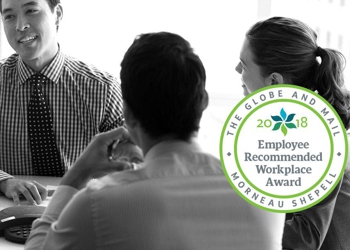
The Globe & Mail and Morneau Shepell have partnered to create the Employee Recommended Workplace Award. This award is based on employee evaluations of "the Total Health of a workforce -- physical, mental, work, and life." Companies with a Canadian staff of 25 or more employees can participate through an application process and then have employees complete an online survey.
Once the survey is completed, participating organizations receive an Employer Report providing an aggregate view of Total Health of the workplace. Winners of the award are recognized as "Employee Recommended Workplaces." They can use that designation in recruiting and other communications.
A major benefit of this process is providing unfiltered feedback to organizational leaders on the state of their workplace. This can help in developing strategies to leverage and build on strengths while pinpointing areas for further development.
Great workplaces reflect great cultures and lead to great results -- for everyone. I recommend you check out the award. Go to Employee Recommended Workplace Award for more information.
Tweet Reading: Recommended Online Articles
 |
 |
This section summarizes last month's LinkedIn Updates and Twitter Tweets about online articles or blog posts that I've flagged as worth reading. These are usually posted on weekends when I am doing much of my reading for research, learning, or leisure. You can follow me on Twitter at https://twitter.com/JimClemmer
My original tweet commenting on the article follows each title and descriptor from the original source:
Traditional performance appraisals are destructive and must be replaced with skillful coaching and feedforward.
"What Solid Research Actually Says About Performance Appraisals" -- Jack Zenger
www.forbes.com
"The world is currently witnessing a dramatic change in the practices of performance management. Ratings are being abandoned and replaced with discussions about performance."
As change accelerates, Zenger Folkman research shows how leaders can make high-quality decisions quickly and accurately.
"Your Indecision Is Costing Too Much! 8 Proven Behaviors To Help You Be More Decisive" -- Joe Folkman
www.forbes.com
"Bad decisions can put organizations in jeopardy for obvious reasons, but delayed decisions can also hurt by losing competitive advantage. Organizations need leaders who can quickly look at the facts, discuss options, and make a decision."
Zenger Folkman research provides a practical menu of behaviors that build confidence.
"How To Effectively Grow Your Confidence At Work" -- Joe Folkman
www.forbes.com
"For those who lack confidence, or those trying to build the confidence of others, learn what behaviors create a high probability of building confidence."
A few practical tips for dealing with that person that drives you crazy.
"How to Deal with Toxic People at Work" -- Dr. Robert I. Sutton, Greater Good Magazine
https://greatergood.berkeley.edu
"Dr. Robert I. Sutton explains how to protect yourself from jerks at work."
A look at the "dark side" personality traits that cause leaders to fail -- and hurt their organizations.
"Check your behaviour: Have you unknowingly joined the dark side?" -- Shane Schutte
https://realbusiness.co.uk/
"Research suggests that most leaders derail or fail by unknowingly 'joining the dark side'. Your behaviour, it seems, can become your kryptonite."
Read The Leader Letter in Weekly Installments

The items in each month's issue of The Leader Letter are first published in my weekly blog during the previous month.
If you read each blog post (or issue of The Leader Letter) as it's published over twelve months you'll have read the equivalent of a leadership book. And you'll pick up a few practical leadership tips that help you use time more strategically and tame your E-Beast!
Feedback and Follow-Up
I am always delighted to hear from readers of The Leader Letter with feedback, reflections, suggestions, or differing points of view. Nobody is ever identified in The Leader Letter without their permission. I am also happy to explore customized, in-house adaptations of any of my material for your team or organization. Drop me an e-mail at Jim.Clemmer@ ClemmerGroup.com or connect with me on LinkedIn, Twitter, FaceBook, or my blog!
May the Force (of strengths) be with you!

Jim Clemmer
President
Phone: (519) 748-5968
Email: jim.clemmer@clemmergroup.com
Website: www.clemmergroup.com


In this Issue:
| View PDF Version |
| Past Issues |
| Practical Leadership Blog |
| Visit Our Site! |
Let's Connect
 |
 |
 |
 |
 |
Share this!Please forward this newsletter to colleagues, Clients, or associates you think might be interested -- or on a 'need-to-grow' basis.Was this forwarded to you? Subscribe to receive The Leader Letter monthly! |
Permission to ReprintYou may reprint any items fromThe Leader Letter in your own printed publication or e-newsletter as long as you include this paragraph. "Reprinted with permission from The Leader Letter, Jim Clemmer's free e-newsletter. For almost forty years, Jim's 2,000+ practical leadership presentations and workshops/retreats, seven bestselling books, columns, and newsletters have been helping hundreds of thousands of people worldwide. His web site is www.clemmergroup.com." |
Please forward this newsletter to colleagues, Clients, or associates you think might be interested -- or on a 'need-to-grow' basis.
Did you receive this newsletter from someone else?
Subscribe to ensure you don't miss the next issue!
The CLEMMER Group
10 Pioneer Drive, Suite 105, Kitchener ON N2P 2A4
Phone: (519) 748-1044 ~ Fax: (519) 748-5813
service@clemmer.net
www.clemmergroup.com
©2017 Jim Clemmer and The CLEMMER Group