


Issue 156 - March 2016
The Leader Letter

In his 1973 book Reflections on the Human Condition, social philosopher, Eric Hoffer wrote, "In a time of drastic change it is the learners who inherit the future. The learned usually find themselves equipped to live in a world that no longer exists."
How true that's proven to be over the past few decades. If we're not growing, we're like a dying tree; eventually the winds of change will snap us off our rotting trunks and blow us over.
The famed ancient Greek mathematician Euclid was hired to teach geometry to a young, impatient Egyptian heir to the throne. The prince was an unmotivated student. He especially resisted learning basic formulas and theories before getting into practical applications.
"Is there no simpler way you can get to the point?" he asked. "As the crown prince I should not be expected to deal with such trivial and useless details." Euclid's response was destined to be paraphrased by teachers throughout the ages: "I am sorry, but there is no royal road to learning."
In her March 2016 Harvard Business Review article, "Learning to Learn," Erika Andersen reports on four attributes critical to effective learning;
- Aspiration – focusing on what we'll gain from the learning and envisioning a happy future of reaping those rewards
- Self-awareness – getting feedback on how others see us to counterbalance our biased or flawed self-perceptions
- Curiosity – self-talk to ask "curious questions" helping us approach learning we find boring to make it more interesting
- Vulnerability – accept being in a beginner state and learn from mistakes while using positive self-talk to build confidence
This issue outlines learning attitudes defining great leaders. We'll also look at how leadership -- and learning -- flows downhill. Cultures fostering open communication create learning organizations. You'll also find a few new opportunities for leadership and coaching learning opportunities.
When learning is a way of life rather than a phase of life we become victors rather than victims of change.
Five Attitudes that Define Great Leaders

Many succession planning processes involve identifying and developing high potential leaders. As with promising amateur athletes working to secure very scarce spots at the professional level of their sport, not every leader considered to have strong potential grows in their career to ever higher leadership roles.
Through our evidence-based approaches to identifying key leadership skills we know which behaviors as assessed by direct reports, peers, manager, and others separate the good, the bad, and the extraordinary leaders. But what are the underlying beliefs or attitudes of outstanding leaders?
Recently Zenger Folkman examined that question by correlating 360 assessments for a group of high potential leaders with an additional twenty-five attitude questions. They found that five attitude questions correlated strongly with leadership effectiveness:
- If I disagree, I usually let others know.
- I am willing to take more risks than most of my peers.
- It's easy for me to make friends.
- I take time to look at all the facts before making decisions.
- I am strategic and future focused.
You can read more about these attitudes in Joe Folkman's Forbes column, "5 Attitudes that Define Great Leaders."
What seem to underlie these questions are assertiveness, interpersonal skills, confidence, and big picture thinking. As with aspiring athletes, some leaders are highly coachable and open to feedback and development. Others...not so much.
I've found that leaders who don't successfully grow to fill the potential others see in them tend to be defensive, insecure, less relationship-oriented, and prone -- often emotionally -- to micromanaging or fixing today's problems.
How coachable are you or your high potential leaders? How do these attitudes describe the chances of succeeding in your personal development or succession planning efforts?
2016 Extraordinary Leadership Summit: New Speaker Roster and Advanced Pricing

This July will be the fifth Zenger Folkman annual leadership summit I've attended. These are powerfully condensed learning opportunities providing unique opportunities to:
- Gain deep insights and experiences from top global leaders in talent development
- Learn about the latest research on leadership, coaching, and culture development
- Participate, evaluate, or become certified in multiple award winning leadership programs
- Connect, exchange ideas, network, and learn from peers around the globe
- Chat with Jack Zenger and Joe Folkman about their decades of research and development experience
Zenger Folkman has just received 3 top awards at LEAD2016. For more than 33 years, Leadership Excellence, now a part of HR.com, has identified and recognized the top leadership organizations and their strategies and solutions in a yearly ranking by appropriate category. The prestigious Leadership Awards salute the world's top leadership practitioners and programs. This year Zenger Folkman was recognized in three areas for their renowned leadership programs:
- Best Experienced/Senior Leaders Program
- Best Global/International Leadership Program
- Best Executive Coaching
You can participate in, evaluate, or become certified to deliver either or both The Extraordinary Leader/The Extraordinary Coach programs at the summit. This year we'll be introducing Leadership Levers: Building Critical Strengths. You can participate in, evaluate, or become certified to deliver this new strengths development program. Elevating Feedback will also be available for participation, evaluation, or certification.
This year's Leadership Forum & User Panel will help you learn from today's global leadership experts during this exclusive forum designed for sharing fresh approaches to growing leadership talent:
- Jennifer Roberts, Director of Talent Strategy & Development, AT&T
- Ryan Cornwell, Organizational Development Lead, Sports Authority
- Dr. Tobias Kiefer, Global Learning Leader -- Advisory, Ernst & Young
- Todd Zenger, N. Eldon Tanner Professor of Strategy and Strategic Leadership, University of Utah
The summit will run from July 12 – 14 with certification from July 11 – 15 at The Hilton City Center in Salt Lake City, Utah. You can save up to $500 by registering before March 31. Click here for more details on the summit and registration.
I hope to see you in July.
Leadership Flows Down Hill

We're currently working with an organization embarking on an extensive leadership and culture development process. It's starting in a series of workshops and planning retreats with the CEO and his team of direct reports along with their direct reports. The first part of the process is our strengths-based 360 assessment.
The CEO is actively engaged in his own development and leading by example. In preparing for the work over the past months I felt he was an extremely strong leader and expected his 360 assessment would show that. It certainly has. Rated by over 15 of his direct reports, boss, peers, and others he is what we define as an extraordinary leader; in the top 10 percent of leaders in our database of over 75,000 global leaders. His involvement and personal development example bodes extremely well for the long term success of this development initiative.
Unfortunately, this is not all that common. Too often senior leaders are "too busy" to participate in leadership development exercises. Giving lots of lip service to the importance of leadership and organization development they approve budgets to develop (or "fix") other leaders.
This is a major mistake. As Zenger Folkman's research from 360 assessment data on 11,925 leaders at all levels show, senior leaders set the ceiling for leadership skills. Middle or lower level leaders don't raise their leadership skills above their leaders.
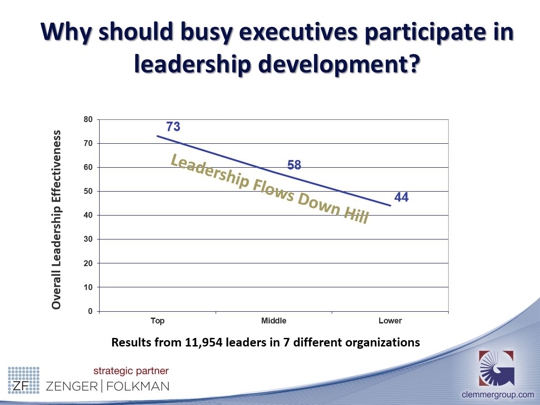 |
As leadership skills flow down the organization, engagement levels also reflect these trends. With a mini-engagement survey embedded in each 360 we clearly see that a leader's effectiveness impacts not only their direct reports' engagement but also engagement of the next level.
You can read an overview of this research in Joe Folkman's Forbes article, "Does Your Boss Need Some Leadership Development?" Joe and Jack Zenger expanded on this research in their webinar World Class Executive Development – 4 Elements That Will Make Leadership Development More Successful!
How high is the pinnacle of your organization's hill from which leadership skills flow? Are top leaders setting a high and rising beginning point?
The Extraordinary Leader Workshop Now Available Online

Traditional assessments and needs analysis look for gaps. And most 360 feedback tools focus on finding and fixing weaknesses. This often leads to:
- Participants feeling beat up by feedback reports
- Negative response or avoidance of 360 multi-rater feedback tools
- Erosion of confidence
- Defensiveness and fear of making mistakes
- Data denial and feedback phobia
- Working on a weak area and only getting it to average -- with mediocre results
- A belief that extraordinary leadership is achieved by naturally gifted or "born leaders"
It's the presence of strengths -- not the absence of weaknesses -- that defines highly effective leaders. Building strengths is proving to be the only way to move from an average or ordinary leader to extraordinary or exceptional. In a series of studies looking at the impact of leaders choosing to fix weaknesses versus building on existing strengths, leaders who magnified their existing strengths showed two – three times more improvement in leadership effectiveness than leaders who worked on fixing their weaknesses.
What's especially remarkable is how obtainable extraordinary leadership is proving to be. A leader needs to develop just three existing strengths to catapult his or her leadership effectiveness from the 34th to the 80th percentile.
The Extraordinary Leader Workshop is now available online. Zenger Folkman's Live Online Workshop will be delivered in two 3-hour sessions on April 5 and 7 by a live facilitator. You'll get the same award-winning content and learning objectives as the in-person workshop.
During the online workshop, a Zenger Folkman facilitator will help you:
- Understand the significant on-the-job performance differences between "good" and "extraordinary" leaders
- Learn the 16 leadership competencies that differentiate extraordinary leaders
- Discover why enhancing existing leadership strengths is the most successful way to become an extraordinary leader
- Prepare to receive an individual 360-degree leadership feedback report, understand the report structure, interpret the data, and discuss how it can best be used in a positive way
- Perform a step-by-step analysis of your feedback report using a structured process with individual and group exercises
- Use Zenger Folkman's unique leadership cross-training approach to construct a customized Individual Development Plan
Click here for more details and registration.
10 Critical Factors Impacting a Safety Culture

Most safety problems have deadly or life altering consequences. That's especially true in healthcare organizations. Medical errors, quality of care, and infection rates are clear examples.
In a recent study published by the American College of Surgeons, Dr. Martin Makary, professor of surgery and health policy and management at Johns Hopkins University School of Medicine, Baltimore reports, "while we have traditionally only studied the incremental patient benefits of different medications and surgical interventions, it turns out that organizational culture has a big impact on patient outcomes."
The study looked at the impact of organizational culture and teamwork on patient outcomes by studying surgical site infection rates after colon procedures at seven Minnesota hospitals. They found these ten factors influenced infection rates:
- Overall perceptions of patient safety
- Teamwork across units
- Organizational learning
- Feedback and communication about error
- Management support for patient safety
- Teamwork within units
- Communication openness
- Supervisor/manager expectations of actions promoting safety
- Non-punitive response to error
- Frequency of events reported
This study found that "the way we do things around here" was "a compilation of burnout, perceptions of management, the connectedness of care, and staff's willingness to speak up when they have a concern." Dr. Makary concluded, "Variation in organizational culture may be an important factor in understanding the broader endemic issue of variation in medical quality."
If your organization is concerned about safety how does your culture measure up against these 10 factors? How do you know -- where's your data?
Team building and organizational culture is the major determinant of health and safety. It's also a key factor in profitability, productivity, customer service, quality, innovation, and other critical performance outcomes. On March 9 I am delivering a complimentary 60 minute webinar on proven frameworks and best practices that empower executive teams -- and their organizations -- to develop a peak performance culture. Click here for details and registration.
Are Urgent Operational Issues Crowding Out Your Strategic Effectiveness?

There are many reasons leadership teams allow their priorities to be badly distorted. Things that matter most -- team dynamics, key strategic priorities, and organization change and development efforts -- are often crowded out by things that matter least -- the crisis du jour or technical problems better solved by those closest to the action.
Like a gnarled root system, common causes of failure are intertwined with personal, team, and organizational behaviors and conditions. A major factor is how the organization's culture ripples out from the management team leading it. The executive team models behavior patterns that set the tone and examples for the entire organization.
Executive team effectiveness and organizational factors are often rooted in these underlying causes:
- Speed Traps and Tyranny of the Urgent
- Partial and Piecemeal Programs
- Leadership Lip Service
- Not Building Change Capacity
- Teams Not Pulling Together
- Communication Breakdowns
- Failing to Follow Through
A Leadership Team Retreat is an excellent way to ensure everyone is pulling together and focused on a shared strategy to dramatically boost the success of development efforts. A well facilitated retreat will:
- Leverage team and organizational strengths
- Pull together major change efforts and development initiatives under an integrated implementation plan
- Develop a strong buy-in and agreement on leadership behaviors needed for leadership/organization development
- Help everyone better understand and lead the interconnected elements to building a high performing organization
- Integrate succession planning, talent development, and performance management with organizational strategy actively led by the leadership team
- Re-energize and refocus the leadership team so they can mobilize the organization
- Build broad and cascading change coalitions and robust infrastructure for strong and sustained follow through
I'll give an overview of these and many other points in my complimentary March 9 Executive Team Building and Culture Development webinar (click for more details and registration).
Communication Breakdowns: Open Door and Closed Mind

Most managers proclaim an open door policy. "You can always come and see me about any problems or issues" they say. Or they'll leave team meetings they've chaired believing there aren't any issues or objections to plans they've set since no one spoke up.
Before running a Moose-on-the-Table workshop for a management team, I had a phone conversation with the leader. We agreed to have participants confidentially send me their response to our Moose Hunting survey for compilation and discussion at the workshop. He was quite confident they had an open atmosphere and there weren't many issues that the team wasn't addressing. He was wrong. It soon became clear that the team wasn't having authentic communication or courageous conversations.
As we worked our way through the workshop it became clear that a combination of fear and futility was stifling communication and causing problems for the team. In their January-February 2016 Harvard Business Review article, "Can Your Employees Really Speak Freely?" James Detert and Ethan Burris identify "a fear of consequences for speaking up and a sense of futility" as the main barriers to open communication.
That was clearly the case here. The leader used subtle -- and not so subtle -- ways to emphasize that he was in control; a big cloistered office guarded by a strong personal assistant, reserved parking spot, vocal and strong opinions expressed first, the most air time and control of meetings, micro managing endless details, and so on.
The more common problem is futility; people have given up raising tough or touchy issues because nothing much changes. This is often a conditioned or learned response modelled by leaders.
Detert and Burris give these suggestions for creating a more vocal culture:
- Make feedback a regular, casual exchange
- Be transparent
- Reach out
- Soften the power cues
- Avoid sending mixed messages
- Be the example
- Close the loop
Courageous conversations, building a culture of open communication, and moose hunting are key themes in my only work of fiction Moose on the Table: A Novel Approach to Communications @ Work. I'll also discuss these further in my March 9 complimentary webinar Executive Team Building and Culture Development.
Tweet Reading: Recommended Online Articles
 |
 |
This section summarizes last month's LinkedIn Updates and Twitter Tweets about online articles or blog posts that I've flagged as worth reading. These are usually posted on weekends when I am doing much of my reading for research, learning, or leisure. You can follow me on Twitter at https://twitter.com/JimClemmer
My original tweet commenting on the article follows each title and descriptor from the original source:
A good look at the vital role of feedback in moving from a fixed to a growth mindset for learning and development.
"Stuck In Your Career? Here's How To Stop 'Proving' And Start 'Improving' Instead" -- Jack Zenger
www.forbes.com
"Our evidence strongly suggests that people can change and significantly improve. But in order to do so, they need to stop "Proving" and start looking for ways to "Improve."
In a series of 1:1 coaching sessions with 17 High Potential leaders I am also finding these attitudes define the most effective leaders.
"5 Attitudes That Define Great Leaders" -- (search on Folkman for his column) -- Joe Folkman
www.forbes.com
"In addition to the 360 assessment we gathered data from each person on 25 attitude questions. We found that five of the attitude questions correlated strongly with overall leadership effectiveness."
Drawing from research on 57,000 leaders to answer vital leadership questions in today's more complex organizations and technological world.
"Are You Technical Enough? Here's How It Affects Your Leadership Skills" -- Jack Zenger
www.linkedin.com
"Can a leader with low levels of technical or financial acumen in a particular business be successful today?"
Read The Leader Letter in Twice Weekly Installments

The items in each month's issue of The Leader Letter are first published in my twice weekly blog during the previous month.
If you read each blog post (or issue of The Leader Letter) as it's published over twelve months you'll have read the equivalent of a leadership book. And you'll pick up a few practical leadership tips that help you use time more strategically and tame your E-Beast!
Feedback and Follow-Up
I am always delighted to hear from readers of The Leader Letter with feedback, reflections, suggestions, or differing points of view. Nobody is ever identified in The Leader Letter without their permission. I am also happy to explore customized, in-house adaptations of any of my material for your team or organization. Drop me an e-mail at Jim.Clemmer@ ClemmerGroup.com or connect with me on LinkedIn, Twitter, FaceBook, or my blog!
May the Force (of strengths) be with you!

Jim Clemmer
President
Phone: (519) 748-5968
Email: jim.clemmer@clemmergroup.com
Website: www.clemmergroup.com


In this Issue:
| View PDF Version |
| Past Issues |
| Practical Leadership Blog |
| Visit Our Site! |
Let's Connect
 |
 |
 |
 |
 |
Share this!Please forward this newsletter to colleagues, Clients, or associates you think might be interested -- or on a 'need-to-grow' basis.Was this forwarded to you? Subscribe to receive The Leader Letter monthly! |
Permission to ReprintYou may reprint any items from The Leader Letter in your own printed publication or e-newsletter as long as you include this paragraph: "Reprinted with permission from The Leader Letter, Jim Clemmer's free e-newsletter. For almost thirty years, Jim's 2,000+ practical leadership presentations and workshops/retreats, seven bestselling books, columns, and newsletters have been helping hundreds of thousands of people worldwide. His web site is www.clemmergroup.com." |
Please forward this newsletter to colleagues, Clients, or associates you think might be interested -- or on a 'need-to-grow' basis.
Did you receive this newsletter from someone else?
Subscribe to ensure you don't miss the next issue!
The CLEMMER Group
10 Pioneer Drive, Suite 105, Kitchener ON N2P 2A4
Phone: (519) 748-1044 ~ Fax: (519) 748-5813
service@clemmer.net
www.clemmergroup.com
©2016 Jim Clemmer and The CLEMMER Group