


Issue 141 - December 2014
The Leader Letter

Throughout my work I've quoted extensively from Martin Seligman's pioneering work in founding the breakthrough field of positive psychology. This is the study of positive emotion, positive character traits, and positive institutions to raise the importance of psychological health around the world. His most recent focus has been on helping people move from enjoying a good life to flourishing. This involves changing our focus from what's wrong or where we're lacking, to building on our strengths and what brings us the deepest meaning and purpose.
Seligman has written over 250 scholarly articles and 20 books. I've reviewed and drawn most from his books, Learned Optimism, Authentic Happiness, and Flourish. It was my search for methodologies to implement these approaches within our leadership and organization development services that drew me back to reconnect with Jack Zenger and his company. Zenger Folkman's advanced strengths-based methodologies are building an impressive track record in helping leaders and organizations flourish.
I was delighted to learn that Martin Seligman was just honored with the inaugural Tang prize. This is a new $100,000 award created by Dr. Fay Tang of the Tang Foundation to recognize individuals who have made an indelible impact on the field of psychology. The prize is administered by the University of Toronto's Department of Psychology.
The halo effect discussed in this issue is an example of the magnifying power of strengths-based leadership development. You can also review my short video clip defining the vital skill of coaching so critical in building strengths and helping others flourish. And you'll see how extraordinary leaders strengthen psychological health by helping others take ownership and accountability for his or her actions. Strong leaders either nurture or neuter that personal initiative.
We'll also look at ineffective leadership and how ignorance isn't bliss, it's blindness that often leads to destruction. And we'll gain insights from new Conference Board of Canada research on the shaky state of leadership development and a joint webinar we're broadcasting on December 17 to address a few of the opportunities.
May you find a few ideas here to positively impact your own psychology and build leadership strengths!
Leveraging The Power of The Halo Effect
 As I wrote in "Perceptions Are a Leader's Reality" a leader's impact on others is dramatically increased by the presence of a few towering strengths or sharply reduced by one or two glaring weaknesses. This halo or horns effect was first documented with empirical research by Edward Thorndike, an early 20th century pioneering American psychologist. Based on his research asking commanding officers to rate their soldiers he found there was "a marked tendency to think of the person in general as rather good or rather inferior and color the judgments of the qualities by this general feeling." Thorndike called this the "halo effect" in his 1920 article "A Constant Error in Psychological Ratings."
"Confirmation bias" has now been well documented as our tendency to look for supporting evidence that confirms our positive or negative impressions and overlook contrary indicators. For example, research shows that attractive people are considered to be friendlier, more intelligent, and successful. Sports super stars (when they have a squeaky clean image) sell us cars, watches, airlines, and other products completely unrelated to their expertise. And the horns effect trashes their credibility when they're caught using illicit drugs or embroiled in personal scandals.
The power of the halo effect has huge implications for leadership development. As I wrote in "Exceptional Leaders Aren't Well Rounded" traditional development approaches use a model, framework, or set of leadership competencies as if all leadership qualities were all equal. The underlying -- and unfounded -- belief is that improving weaker areas will lead to increased leadership perceptions and effectiveness.
Without the multiplying bias of the halo effect, that might be true. Our database of over 500,000 multi-rater assessments on more than 50,000 leaders shows here's what really happens:
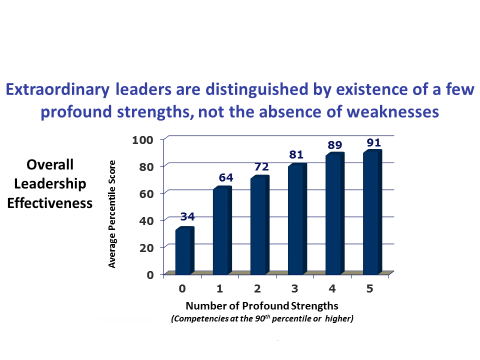
When a leader has no profound strengths (competencies rated at the 90th percentile) their overall leadership effectiveness is at only the 34th percentile. This is average or ordinary leadership that leads to mediocre outcomes -- average levels of engagement, quality, safety, sales, customer satisfaction, etc.
The halo effect from having one profound strength almost doubles his or her overall perceived leadership effectiveness to the 64th percentile! Just three profound strengths elevates the leader to the top 20% of all leaders and 5 profound strengths makes him or her an extraordinary leader in the top 10% of all leaders.
Exceptional leaders like Steve Jobs, Kennedy, Churchill, or Gandhi were far from perfect human beings. The impact of a few of their towering strengths lit up a halo so powerful it cast dark shadows over their weakness and illuminated bright new pathways.
7 Habits of Highly INeffective People

As shown in the extensive research of our web site section, Focusing on Strengths, we have overwhelming evidence that building strengths is 2 to 3 times more effective than fixing weaknesses, closing gaps, or "rounding out" lower leadership skills.
But when a weaker leadership skill crosses the line into fatal flaw territory the "horns effect" dramatically changes the picture. The polar opposite of the "halo effect" a fatal flaw creates a perceptional distortion that overshadows and pulls down a leader's stronger areas to the point they may not be noticed or appreciated.
The blinding glare of just one fatal flaw means that a leader's overall effectiveness is rated in the lower 20% of his or her peers. Two or more fatal flaws put a leader in the bottom 10%. We've correlated this into scraping the very bottom of employee engagement, productivity, turnover, customer service, safety, and profitability. Leaders who don't address their fatal flaws destroy people, teams, organizations -- and their careers.
Jack Zenger and Joe Folkman recently published a CNN article on their study of 52,000 leaders to determine the very worst behaviors that differentiated the very worst leaders. Here's what they found rank ordered from the least to the most fatal:
- Failure to Coach and Develop Others
- Bad Role Model
- Lack of Strategic Perspective
- Prefer Working Independently Instead of Collaborating
- Resist Goals and Improvement
- Poor Communication
- Failure to inspire and motivate others
The deadly fatal flaw spiral is accelerated by the leader's lack of awareness about how he or she is perceived. Like the drivers who rage against others and rate themselves as above average, we often see badly rated leaders rate themselves much higher than everyone else does.
Our research shows that self-assessments are only half as accurate as a 360 assessment with perceptions aggregated from direct reports, peer, manager(s), and others. Learn more at Feedback Power and Problems and take steps to reverse the fatal flaw spiral or avoid highly ineffective leadership behaviors.
Video Clip on the Difference between Training, Mentoring, and Coaching
I've written extensively about coaching skills development. Many of my leadership books have full chapters on coaching and developing. We have also designed and delivered numerous coaching skills development workshops.
Two years before we formed a strategic partnership with Zenger Folkman I reviewed their new book, The Extraordinary Coach: How the Best Leaders Help Others Grow. It was (and is) by far the best book on coaching available.
Now that I've been delivering The Extraordinary Coach workshops for the past few years, I've been even more impressed by the ground breaking approach Zenger Folkman has developed. A key distinction at the foundation of The Extraordinary Coach is clarifying the difference between training, mentoring, and coaching. Most people confuse and intertwine the three approaches. Pulling them apart and using a four step FUEL model for coaching is proving to be highly effective.
In a three minute video clip, The Difference between Training, Mentoring, and Coaching, I give an overview of this vital distinction and explain the four steps of the FUEL model to guide more effective coaching conversations.
I am delivering public workshops of The Extraordinary Coach in Toronto in December. This one-day session (our two-day version includes our newly revised Elevating Feedback module as well as a specific strengths-based 360 coaching assessment) creates the most dramatic shifts in thinking and participant skills that I've ever seen happen.
Related Blogs- "Untangling the Training, Mentoring, Coaching Confusion"
- "Bringing Science to the Art of Coaching"
- "Coaching Survey: Big Need for Skill, Feedback, and Measurement"
A Snapshot of Leadership Development Practices in Canada

The Conference Board of Canada recently published a report summarizing their research on leadership development from a cross section of public and private sector organizations. Participants identified their top leadership development drivers as:
- addressing declining levels of leadership capacity
- planning for succession and growing the talent pool
- engaging and mobilizing employees
- managing changing demographics and retirement challenges
- attracting and retaining new talent
81% of respondents said leadership development was a strategic priority. Given research cited in the report that organizations with the highest quality of leadership are 13 times more likely to outperform their competitors on metrics including financial performance, quality of products and services, and employee retention and engagement, it's almost a "motherhood question."
The glaring gap between intentions and actions was highlighted when researchers Katie O'Brien and Colin Hall asked how important leadership development was relative to other organizational priorities. Only 31 percent reported that their organization actually puts a high priority on leadership development.
This rich report is full of information and insights. Here are a few that stood out:
- Succession planning was the number one driver of leadership development. But it's been mostly focused at the executive level and weak through management and very weak supervisory levels. Organizations aren't building leadership depth to draw future leaders from.
- Performance management linked to leadership development strategies was highly rated as a key talent management practice.
- Less than a quarter of organizations are measuring competency growth over time. This aligns with our experience that many competency models are not being used effectively.
- Most best-performing companies (100 percent in North America and 96 percent globally) have a formal process to identify their high potentials. Researchers discovered that only 39 percent of participating Canadian organizations have a leadership development program for their high potentials.
- A survey by MetrixGlobal found that coaching produced a 529 per cent return on investment. Coaching was perceived as the most effective leadership development practice by respondents, yet is only used 73 per cent of the time.
- Most organizations surveyed (66 per cent) are not formally evaluating their leadership development investments.
Recommendations
Based on their research the report concludes with these recommendations:
- Make leadership development a strategic priority
- Align leadership development practices with changing demographics
- Identify organization-specific leadership competencies
- Formally identify and focus resources on developing high-potential employees
- Allocate resources to the leadership development practices that are the most effective
- Measure and evaluate leadership development
My next blog post will outline an upcoming Conference Board of Canada webinar I'll be participating in on December 17 to discuss the research report findings and how to act on them.
Join Me for a Conference Board Webinar on Leadership Development in Canada
The Conference Board's recent study on the state of leadership development in Canada shows serious shortcomings and lots of improvement opportunities (see my last blog). The results are also supplemented by interviews with five Canadian organizations that are making a best-in-class impact with their leadership development programs. Click here for a report overview and reviews of it.
Leaders are being pushed to be "lean and efficient" while enhancing innovation, collaboration, and partnerships. As many Canadian senior leaders near retirement the nature of leadership is changing. The need for leadership development has never been more pressing.
On Wednesday, December 17, 2014 at 2:00 p.m. ET I am participating in The Conference Board of Canada's Leadership Development in Canada: A Webinar on the Snapshot of Practices and Opportunities. This webinar will overview "A Snapshot of Leadership Development Practices in Canada" that's now been read by over 500 HR executives across Canada.
This session will be hosted by Donna Burnett-Vachon, Associate Director of the Leadership and Human Resources Research Division of The Conference Board of Canada. Donna will share results from the Conference Board survey that provided details for the report. She will also share details on the Canadian organizations profiled in the report that are making a positive impact with their leadership development programs.
I'll join Donna to draw from our research and experiences for building best-in-class leadership development programs. I am excited to outline the strong alignment and synergy in our research. The Conference Board's report points to what the greatest leadership development opportunities are and I'll outline key how-to steps based on ground breaking leadership science and new methodologies.
During this session, you will hear about:
- the business issues that are driving leadership development
- the impact the economic environment has had on leadership development practices
- how leadership development is prioritized within organizations
- which HR programs are linked to leadership development
- how leadership competencies are being used and can be much further enhanced
- ways to identify and develop high-potential talent
- the link between leadership development practices and changing demographics
- the mismatch between use and perceived effectiveness of leadership development programs
- how organizations are measuring the impact of leadership development
- proven steps to build leadership strength
The fee for Leadership Development in Canada: A Webinar on the Snapshot of Practices and Opportunities is $249. This includes:
- access to the live webinar and the Q&A session
- the recording that you can share with your entire organization -- get everyone on the same page when it comes to leadership development
- a copy of Conference KeyNotes - The 2014 Leadership Development Conference: Identifying Your Company's Leadership DNA. This Conference KeyNotes summarizes discussions held at the Leadership Development Conference in 2014. The briefing (10-pages, value of $205) looks at the characteristics of a successful leader, the characteristics of a successful leadership development program, and focuses on company leadership development programs.
Click here to register. I hope to see you at the webinar.
Dealing with an Ineffective Boss

Recently we had a web site registration with "ineffective manager" filled in under title. When we sent an e-mail verification to "Tanya's" -mail address we learned she had not registered for access and was mystified as to who did. Our best guess is that one of Tanya's colleagues or direct reports signed her up in an effort to give her some not-so-subtle feedback.
It's easy to sail a ship when the sea is calm. It's easy to look like a brilliant investor in a bull market. And it's easy to be positive when we have an optimistic, supportive, and highly effective boss. What takes courage, skill, and Emotional Intelligence is upward leadership, when we have a weak or a bad boss. You may have a boss who needs a surge protector to buffer his or her mouth from emotional outbursts. Or a wind sock outside his or her office to gauge abrupt changes in direction.
The lousier your boss or those higher up in your organization are at setting priorities, the better you and your team must be at stepping into the breach. You may need a daily, weekly, or monthly process to reset your goals and priorities as conditions and demands change.
Try to better understand the bigger picture that your boss and others above you in the organization are operating within. Do you know what keeps them awake at night? What are their key goals and priorities? Don't wait to be told -- find out. Don't wait for your boss or someone else to open the door. The handle is on the inside.
Dealing with a boss is what clearly separates the wallowers and followers from the leaders. Wallowers will complain bitterly that their boss doesn't communicate and give them the information they need. Followers will passively wait for the information and perhaps understand that their boss is busy, disorganized, or not getting the information from above. Leaders will ask questions, quietly persist or gently insist until they get the information they need. This takes skill, this takes initiative, and this takes courage. This is leadership.
Whomever was trying to send Tanya a message about her leadership obviously didn't read too deeply into the advice on our web site. If he or she was a direct report she could type "upward leadership" (with the quotation marks) in our site search engine and find 18 articles and blogs to peruse on the topic (an even broader selection is at Serving, Influencing, and Leading Upward) Not one of these resources recommends the approach used in Tanya's case!
Webinar on 8 Critical Behaviors that Leverage Accountability

During one of my workshops we were discussing keys to building responsibility and ownership. One participant told us that he and his wife had their four year old grandson, Tyler, stay overnight at their house. In the morning he came running down the stairs and reported, "Grandma, Grandpa, somebody peed in my bed!"
Kids will often avoid taking responsibility for their behaviors -- especially if they fear punishment or ridicule. This often extends into young siblings or classmates playing "the blame game" as they point fingers at others to avoid being seen as the guilty person for a problem.
Ownership and accountability is a key issue in today's organizations. Whether people embrace ownership and take responsibility for their individual and team performance is highly dependent on leadership. Self-accountability is really all there is. Getting people to take personal ownership is the only way to avoid the blame game. Leadership is the critical factor in fostering accountability or finger pointing.
Imagine a team or organization where everyone takes responsibility for achieving good results. An organization or team where people have a personal sense of ownership, and there is little finger-pointing when things go wrong. When a leader is able to inspire accountability in others, it not only better leverages leadership, but would significantly increase organizational results.
Zenger Folkman's research has discovered eight critical behaviors that leverage accountability. These behaviors create a greater sense of accountability in others. They help to raise the bar on leadership effectiveness.
On November 19 Joe Folkman provided a webinar that covered:
- The 8 BEHAVIORS that increase accountability
- How we can get better at inspiring and motivating
- How to improve accountability within organizations
Tweet Reading: Recommended Online Articles


This section summarizes last month's LinkedIn Updates and Twitter Tweets about online articles or blog posts that I've flagged as worth reading. These are usually posted on weekends when I am doing much of my reading for research, learning, or leisure.
My original tweet commenting on the article follows each title and descriptor from the original source:
More evidence on the pivotal impact of strong leadership on transforming performers from ordinary to extraordinary and exceptional performance.
"Superior Leadership Produces Higher Return Than Superior Talent" -- Jack Zenger
www.forbes.com
"Effective leadership can be developed. It's not a limited, finite resource reserved for a talented few. People can make significant changes. Through effective leadership, organizations can create a winning culture that enables all."
Fascinating research showing the power of front line producers making personal connections to customers.
"Cooks Make Tastier Food When They Can See Their Customers" -- by Harvard Business Review staff
https://hbr.org
"We've learned that seeing the customer can make employees feel more appreciated, more satisfied with their jobs, and more willing to exert effort."
These key steps create self-accountability -- the only way leaders can get others to embrace responsibility and ownership.
"The '8 Great' Accountability Skills For Business Success" -- Joe Folkman
www.forbes.com
"While there were some differences among differing industries, there was also a surprising consistency of the traits and behaviors that executives appear to use in deciding who they will likely promote."
Read The Leader Letter in Twice Weekly Installments

The items in each month's issue of The Leader Letter are first published in my twice weekly blog during the previous month.
If you read each blog post (or issue of The Leader Letter) as it's published over twelve months you'll have read the equivalent of a leadership book. And you'll pick up a few practical leadership tips that help you use time more strategically and tame your E-Beast!
Feedback and Follow-Up
I am always delighted to hear from readers of The Leader Letter with feedback, reflections, suggestions, or differing points of view. Nobody is ever identified in The Leader Letter without their permission. I am also happy to explore customized, in-house adaptations of any of my material for your team or organization. Drop me an e-mail at Jim.Clemmer@ ClemmerGroup.com or connect with me on LinkedIn, Twitter, FaceBook, or my blog!
May the Force (of strengths) be with you!

Jim Clemmer
President
Phone: (519) 748-5968 Fax: (519) 748-2171
Email: jim.clemmer@clemmergroup.com
Website: www.clemmergroup.com


In this Issue:
| View PDF Version |
| Past Issues |
| Practical Leadership Blog |
| Visit Our Site! |
Let's Connect
 |
 |
 |
 |
 |
Share this!Please forward this newsletter to colleagues, Clients, or associates you think might be interested -- or on a 'need-to-grow' basis. Was this forwarded to you? Subscribe to receive The Leader Letter monthly! |
Permission to ReprintYou may reprint any items from The Leader Letter in your own printed publication or e-newsletter as long as you include this paragraph: "Reprinted with permission from The Leader Letter, Jim Clemmer's free e-newsletter. For almost thirty years, Jim's 2,000 + practical leadership presentations and workshops/retreats, seven bestselling books, columns, and newsletters have been helping hundreds of thousands of people worldwide. His web site is www.clemmergroup.com." |
Please forward this newsletter to colleagues, Clients, or associates you think might be interested -- or on a 'need-to-grow' basis.
Did you receive this newsletter from someone else?
Subscribe to ensure you don't miss the next issue!
The CLEMMER Group
10 Pioneer Drive, Suite 105, Kitchener ON N2P 2A4
Phone: (519) 748-1044 ~ Fax: (519) 748-5813
service@clemmer.net
www.clemmergroup.com
©2014 Jim Clemmer and The CLEMMER Group