


Issue 183 - June 2018

We've been using that tagline on bookmarks, our web site, and other development materials for years. It's not just three catchy words that rhyme. There's plenty of evidence to show that many highly effective leaders are avid readers.
In his Harvard Business Review article, "For Those Who Want to Lead, Read," John Coleman writes "deep, broad reading habits are often a defining characteristic of our greatest leaders and can catalyze insight, innovation, empathy, and personal effectiveness." He points out that "history is littered not only with great leaders who were avid readers and writers (remember, Winston Churchill won his Nobel prize in Literature, not Peace), but with business leaders who believed that deep, broad reading cultivated in them the knowledge, habits, and talents to improve their organizations."
Neuroscience is showing that reading is to the mind what exercise is to the body. As an avid reader and author, I'll admit to perhaps a little bias on the importance of leadership books! As Socrates advised way back when, we should improve ourselves by other people's writing so "you shall come easily by what others have labored hard for."
Effective leadership and learning are intertwined more than many people realize. When we see strong leaders we often don't appreciate how hard they've worked to develop their abilities. They make it look so natural. Leadership researcher and author, Warren Bennis, spent much of his career trying to dispel the myth of the born leader. He writes, "Biographies of great leaders sometimes read as if they entered the world with an extraordinary genetic endowment, as if their future leadership role was preordained. Do not believe it. The truth is that major capacities and competencies of leadership can be learned if the basic desire to learn them exists."
Growth is a vital sign of life. We're most alive when we're more than human beings, we're human becomings. As the world and our lives continue accelerating at Mach speed, it's easy for growth to stagnate. We have no time to become more effective, so we speed up our ineffectiveness.
This issue discusses the speed trap that snares many leaders and makes them run faster, not smarter. You'll also see the results of our "readersourcing" survey on book topics and have a chance to participate in stage two of my next leadership book. You can also get high again -- on your career. And we'll discuss a critical learning and development topic; succession planning.
May this issue help you avoid the problem Douglas Adams outlined in his book, The Hitchhiker's Guide to the Galaxy, "Human beings, who are almost unique in having the ability to learn from the experience of others, are also remarkable for their apparent disinclination to do so."
Escape the Speed Trap: Lead Smarter, Not Faster
I once sat through a frantic, high-energy presentation by an author on knowledge management. He deluged us with a flood of statistics showing how the world's knowledge was growing at mind-blowing rates. The gist of his presentation was that we need to re-train our brains to absorb more information at faster rates, so we could cram more stuff in our craniums.
Beware of this lethal speed trap! He's peddling dangerous advice leading to high stress, reduced effectiveness, and exhaustion. In these times of light-speed change, we must get off the ever-accelerating treadmill before we burn out -- or burst a blood vessel! We need to step back to step ahead. We need to slow down to increase our speed.
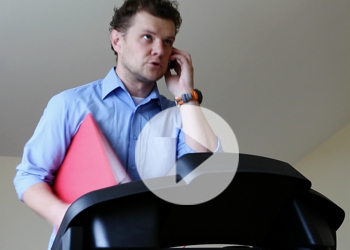
I flashed back to Mr. Speedster this week as we created a 90 second video clip for our June public workshops . We focused on the "I am too busy" explanation leaders often give for not investing time in their development. Far too often they're running faster and faster just to keep up. As the Red Queen said to Alice in Through the Looking Glass, "it takes all the running you can do, to keep in the same place. If you want to get somewhere else, you must run at least twice as fast as that!" We had fun running a video clip of a leader multi-tasking as he ran flat out on a treadmill with "Flight of the Bumblebee" playing in the background and me narrating at break neck (nearly break voice) speed!
In his book, Crazy Busy: Overstretched, Overbooked, and About to Snap, psychiatrist Edward Hallowell, warns,
"you can feel like a tin can surrounded by a circle of a hundred powerful magnets. Pulled at once in every direction, you go nowhere but instead spin faster and faster on your axis. In part, many people are excessively busy because they allow themselves to respond to every magnet: tracking too much data, processing too much information, answering to too many people, taking on too many tasks — all out of a sense that this is the way they must live in order to keep up and stay in control. But it's the magnets that have the control."
This is the harried flight of the bumbling leader. Based on five years of research studying 500 managers, Heike Bruch and Sumantra Ghoshal, published their conclusions in a Harvard Business Review article, "Beware the Busy Manager;" "Fully 90% of managers squander their time in all sorts of ineffective activities... the smallest proportion of managers we studied -- around 10% -- were both highly energetic and highly focused. Not only do such managers put in more effort than their counterparts, but they also achieve critical, long-term goals more often... spend their time in a committed, purposeful, and reflective manner."
In 1891, the Anglo-Irish playwright and author, Oscar Wilde, wrote, "We live in the age of the overworked, and the under-educated; the age in which people are so industrious that they become absolutely stupid." Over 100 years later, as leadership and coaching effectiveness gaps widen, the treadmill of industrious stupidity is speeding up. What's that catchy tune playing in the background? And how did that bee get in here?
In today's frenzied world, it's way too easy to fall into the trap of confusing busyness with effectiveness. That proverbial woodcutter who's too busy chopping trees to stop and sharpen his ax, reminds leaders to keep sharpening their skills. There's a much better flight path to higher results than increasing our speed.
As a road sign on a winding mountain highway warned, "Slow Down or Die."
Readersourcing: The Highest Voted Development Topics

Workplace stress is rising while employee engagement and performance is sinking. A major cause is mediocre managers and bad bosses. The poorest leaders are often the ones who need leadership development the most. But they're too crazy-busy and running faster and faster on their treadmill just to keep up, and don't take time for development.
Not all learners are leaders, but most highly effective leaders are learners. Reading leadership books continues to be a popular way for learning leaders to continue their growth and development. With personal development time getting squeezed ever tighter, leaders want books that:
- Cut through the clutter to the vital topics and applications more relevant in today's fast changing organizations
- Are grounded in research to identify what's practical and easiest to apply
- Succinctly get right to the point
- Entertain and inspires action by lighting logic on fire
I've written about a dozen development books, field guides, and application planners. I've also posted hundreds of blogs across more than 40 development topic areas indexed on our web site. You could say that research and writing about personal, team, and organization development writing is a wee bit of a passion for me.
You know how some "technogeeks" joyfully create features that are really fun for them but regular people don't use? Last year I began to review all that research and writing to identify core themes and topics most relevant in these turbulent times. As a "leadergeek" I want to avoid writing a book that's fun for me but won't help leaders succeed today.
Eight major topic areas emerged. As part of a "readersourcing" project, we invited senior executives, managers, and HR/development professionals to rank order the eight topic areas (with descriptive sub-sections). Nearly 500 people completed the survey.
The envelope please... the top-rated topic areas were:
 |
Gold mining companies crush and process tons of rock to get one ounce of gold. I'd appreciate you joining our Book Advisory Panel to help find "the gold in them thar hills" of development theories and approaches. If you'd like to help, please rate the sub points in the top four topic areas, your opinion on why each one ranked in the top topics, and what you think are the biggest issues a book should address for each topic. Please click on Book Panel Advisory to complete this short readersourcing survey.
A critic once told an author "I'll waste no time reading your book." Your help can keep me from writing a book that wastes time -- and causes me to pull out what little hair I have left.
The Key to Unlocking Your Career Highs Again and Again

What's your combination of strengths or competence, passion, and organizational need for your work? Are you playing to your strengths and filling an organizational need, but it's a real chore and your heart isn't in your work? Then you're likely serving time in "day prison."
What if you're doing work you love, and it plays to your strengths but it's not serving an organizational purpose? Your work might be a professional hobby. That's a dangerous place to be when payroll costs are being tightly scrutinized.
Think back to a career high when you were performing at your peak. You may have been high for days, weeks, or even months (without ingesting anything). You achieved something significant on the job. It's a time you look back on fondly as a career highlight.
Your career high likely resulted from being "in the zone" or sweet spot at the intersection of your strengths, passion, and organizational needs. Many personal development plans fail or careers slide off track from misalignment of these key factors. This has been documented by positive psychology research behind the PERMA framework (positive emotion, engagement, relationships, meaning, and accomplishment) that leads to flourishing lives.
How do we create extraordinary work experiences that can be repeated again and again? Discovering purpose in our work drives personal satisfaction and organizational success. Unfortunately, we often allow ourselves to go too long without it.
Last month Jack Zenger and Joyce Palevitz delivered a complimentary 45-minute webinar and interactive learning experience. During this webinar participants participated in a personal assessment that indicated they are primed for a career high or headed for a danger zone. They used their assessment results, delivered live during the webinar, to discover the actions that will lead to their next extraordinary work experience. Click on The Key to Unlocking Your Career Highs Again and Again! to view the archived webinar.
Jack and Joyce took participants inside a process we use to help leaders build their strengths-based personal development plans based on 360-feedback. I'll be delivering our last 2018 public workshop of The Extraordinary Leader using this process on June 21 in Mississauga (10 minutes from Toronto's airport).
We look forward to helping you get high!
Succession Planning: From Piecemeal Programs to Integrated Strategy

Studies show a growing sense of urgency for succession planning. One survey found 92% of respondents felt it was risky not to have a succession plan for key employees but only 25% of companies feel they've identified adequate successor candidates and less than half have a process for developing candidates. Other research shows 70% of executives think their organization lacks adequate bench strength while nearly 75% of senior managers will retire by 2020. An HR software study reported that over 90% of millennials say working at a company with a clear succession plan would "improve" their level of engagement. Another report found that promoting internal leaders has a success rate of 70-80% while the rate for external leadership hires drops to 50% -- about the same as flipping a coin.
Many organizations recognize the critical need for succession planning. But the way they're approaching this talent development challenge is with piecemeal programs. Too often internal support specialists such as HR, OD, or Talent Management professionals manage the program. They focus on tools like the 9-box grid, competency models, and organization charts. These tools are highly useful. But they're severely limited when they're bolted on the side of the senior leadership team's crazy-busy agenda.
In high-performing organizations, tools and approaches like succession planning are owned and driven by the senior leadership team. They understand that implementation of their strategies and plans are highly dependent on culture development. Talent and leadership development are a vital strategic issue as vigorously managed as sales, marketing, operations, or finance.
Executives often check out (and start checking their email) when a deck of slides is read to them on succession planning tools, models, and processes. But if the senior leadership team is engaged in rich discussions on what their succession issues are and how to address them, they'll quickly shift from passive approvers of their support staff's plans to active leaders and drivers of the process. This becomes even more effective when senior leaders link succession planning to their strategy and culture.
Here are key steps for bringing a senior leadership team into alignment in moving succession planning from bolt-on programs to a built-in strategic process:
- Establish foundational frameworks for leadership/culture development grounded in research. Examples: Excellence/culture models, Performance Balance, or 5 Steps to High-Performance Culture.
- Agree on a shared vision of your desired culture.
- Set/refresh the three or four core values anchoring your desired culture.
- Define the behaviors that model each core value and the negative behaviors that create eye-rolling "yeah, right" reactions to each core value. The clearest signal of an organizations lived (versus espoused) values is who gets promoted for what behaviors.
- Use a safe and anonymous process to identify moose-on-the-table (or elephants in the room) and what must be dealt with to move toward your desired culture.
- Agree on three or four Strategic Imperatives to address your "moose issues" and build an implementation plan for your desired culture. Set up teams for each Strategic Imperative with ownership/accountability, charter/mandate, and timelines.
- Decide on core succession planning tools such as 9 box framework, a competency model for hiring, promoting, and development, high potential programs, software, talent pools, etc.
What's critical to this approach is managing group dynamics, meeting flow, and discussion process. A skilled, external facilitator with a toolkit of group processes, exercises, and applications has a huge impact on the success of planning sessions like this.
In their Harvard Business Review article, "Developing Your Leadership Pipeline," Jay Conger and Robert Fulmer report that high-performing organizations marry succession planning with leadership development. "At the foundation of a shift toward succession management is a belief that leadership talent directly affects organizational performance. This belief sets up a mandate for the organization: attracting and retaining talented leaders."
Tweet Reading: Recommended Online Articles
 |
 |
This section summarizes last month's LinkedIn Updates and Twitter Tweets about online articles or blog posts that I've flagged as worth reading. These are usually posted on weekends when I am doing much of my reading for research, learning, or leisure. You can follow me on Twitter at https://twitter.com/JimClemmer
My original tweet commenting on the article follows each title and descriptor from the original source:
Do you prefer to push or pull? Which one gets the best results? What's the impact of being strong at both?
"Do Leaders Want To Be Drivers Or Inspirational?" -- Joe Folkman
www.forbes.com
"When motivating others, are leaders more effective at pushing (driving hard for results) or pulling (inspiring and motivating others)? Find out what research revealed about leader's strengths and weaknesses in these areas."
It's tough to see our own jerky behavior. It's even tougher to change those behaviors before damaging relationships.
"Dealing with jerks at work"-- McKinsey & Company
https://www.mckinsey.com
"Maybe you don't act like a jerk in the workplace, but you might turn into one when exposed to the following triggers."
Investors and boards are waking up to the pivotal role leadership and culture plays in delivering results.
"CEOs Everywhere Are Talking Talent and Culture" -- Michelle M. Smith
https://www.tlnt.com
"How to attract and retain skilled talent and create a company culture that will help them thrive are the hot topics in the executive suite globally. And for good reason."
John Kador asks five key questions for self-assessment. Getting unfiltered 360 feedback on these issues is vital.
"Are You A Trusted Leader? -- John Kador
https://chiefexecutive.net
"While it's true that trust is built incrementally, trust can occur very quickly under the right circumstances."
Read The Leader Letter in Weekly Installments

The items in each month's issue of The Leader Letter are first published in my weekly blog during the previous month.
If you read each blog post (or issue of The Leader Letter) as it's published over twelve months you'll have read the equivalent of a leadership book. And you'll pick up a few practical leadership tips that help you use time more strategically and tame your E-Beast!
Feedback and Follow-Up
I am always delighted to hear from readers of The Leader Letter with feedback, reflections, suggestions, or differing points of view. Nobody is ever identified in The Leader Letter without their permission. I am also happy to explore customized, in-house adaptations of any of my material for your team or organization. Drop me an e-mail at Jim.Clemmer@ ClemmerGroup.com or connect with me on LinkedIn, Twitter, FaceBook, or my blog!
May the Force (of strengths) be with you!

Jim Clemmer
President
Phone: (519) 748-5968
Email: jim.clemmer@clemmergroup.com
Website: www.clemmergroup.com


In this Issue:
| View PDF Version |
| Past Issues |
| Practical Leadership Blog |
| Visit Our Site! |
Let's Connect
 |
 |
 |
 |
 |
Share this!Please forward this newsletter to colleagues, Clients, or associates you think might be interested -- or on a 'need-to-grow' basis.Was this forwarded to you? Subscribe to receive The Leader Letter monthly! |
Permission to ReprintYou may reprint any items fromThe Leader Letter in your own printed publication or e-newsletter as long as you include this paragraph. "Reprinted with permission from The Leader Letter, Jim Clemmer's free e-newsletter. For almost forty years, Jim's 2,000+ practical leadership presentations and workshops/retreats, seven bestselling books, columns, and newsletters have been helping hundreds of thousands of people worldwide. His web site is www.clemmergroup.com." |
Please forward this newsletter to colleagues, Clients, or associates you think might be interested -- or on a 'need-to-grow' basis.
Did you receive this newsletter from someone else?
Subscribe to ensure you don't miss the next issue!
The CLEMMER Group
10 Pioneer Drive, Suite 105, Kitchener ON N2P 2A4
Phone: (519) 748-1044 ~ Fax: (519) 748-5813
service@clemmer.net
www.clemmergroup.com
©2018 Jim Clemmer and The CLEMMER Group