


Issue 163 - October 2016
The Leader Letter
 I grew up in the small farming community of Milverton, Ontario, in Perth County just north of Stratford. Arden Barker was a farmer, local politician, and well-known community builder. His wife Helen was also very active in the community and wrote a weekly newspaper column filled with her wit, experiences, observations, and philosophies. Helen was highly engaged in life and made everyone she met feel like she got up that day just to make you feel important.
Helen died in 2005. A tribute to her life was held at the Milverton arena and community center, because no other building in the area could hold the large crowd that attended. Helen was a strong supporter of my writing, so her daughter Brenda asked me to read a piece I'd written about the power of recognition, appreciation, and celebration in Growing the Distance: Timeless Principles for Personal, Career, and Family Success. It was an old Barker family story that reinforced appreciating what we've accomplished rather than focusing on what we lack.
During the celebration of Helen's life, Brenda and other speakers reviewed all that Helen had endured: the sudden death of her son Tom at age 19; Arden's premature death at 59; adopting and raising two abused teenage girls later in Helen's life; her years of battling cancer, and other disasters and losses. To her last day, Helen remained thankful for all that life gave her, positive, and concerned with others and the community. It was a unique opportunity to reflect on the life and legacy of a strong leader.
Events like these are times to reflect on what's really important. Happiness research confirms what most of us intuitively know: living a purposeful, meaningful life aligned around our personal values and strengths is critical to enjoying a successful journey for the short time we're traveling on this earth.
This issue provides a range of perspectives on leadership. Alvin Law and the "Yes, I Can," video illustrate resilience and the power of positivity -- much like Helen showed in her life. Leadership lessons from our workshops and global trends show the enduring and universal themes of core leadership principles and the huge impact leaders have on engagement levels. Ultimately, leadership effectiveness grows from personal and organizational growth and development.
Key Leadership Lessons From Our Most Popular Workshop

Of all our custom keynotes and workshops topics, the most popular continues to be variations of Leading @ the Speed of Change. One reason for that is in today's fast-moving world it's easy to be overwhelmed by rapid changes and difficult problems.
While we can't control the changes, we can manage our response. It's not what happens to us but what we do about it -- how we respond -- that makes a world of difference. It's all about perspective or how we frame difficult situations. These critical choices then ripple out to how we help or hinder others dealing with constantly shifting conditions.
Today, more than ever, organizations look to everyone, at all levels, to think and act like leaders. Leadership is clearly the key to success. Strengthening leadership skills to build high-performing management teams and organizational cultures has always been important.
Reflecting on dozens of interactive keynotes and workshops the following themes emerge so consistently that they now form the outline of many of our workshops:
| • | Leadership is an action, not a position - it's our behavior and not our role that determines leadership |
| • | Change or be Changed - If the rate of external change exceeds our rate of internal change, we're going to be changed |
| • | Lead, Follow, or Wallow – these are critical choices in how we frame and deal with challenges and opportunities |
| • | Finding the Right Balance – it's vital to understand the critical differences and intertwined relationship of technical, management, and leadership and assess our "as is" compared to our "should be" |
| • | Soft Skills, Hard Results - emotional intelligence, engagement, perceptions, and energy are powerful catalysts propelling teams and organizations to peak performance |
|
|
| • | Positive Psychology and Leveraging Strengths – mindfulness and fresh research on strengths-based approaches provides maps to new pathways to personal, team, and organization effectiveness |
| • | Development Planning – we need to build personalized improvement plans with a high degree of energy and follow through |
How are you or your team/organization doing at implementing these principles? Developing a leaderful organization calls for leveraging crucial tools and transforming mindsets and behaviors to deal with our rapid pace of change and uncertainty.
Browse our workshops topics for additional details of these key themes. Contact me if you'd like to explore how I might customize a session for your team or organization.
Leadership, Engagement, Culture, and Learning Top Global Trends Survey

Deloitte's Human Capital Trends 2016 identified the top ten organizational issues through surveys and interviews with more than 7,000 business and HR leaders from 130 countries. Other than using the dehumanizing phrase "human capital" (treating people as breathing assets with skin, things, or "head count"), this report provides strong research on what's needed to build stronger people and stronger organizations.
Here's a brief summary of the top five trends:
- Organizational design – over 80% of respondents are currently restructuring or have just restructured their organizations. The shift is toward highly empowered teams driven by networks of internal and external talent to keep pace with a fluid, unpredictable world.
- Leadership awakened – 89% see leadership as important or very important while 28% reported weak or very weak leadership pipelines."High-performing companies outspend their competitors on leadership by almost four times. Not only do they spend more, they spend smarter."
- Culture – 82% believe culture is a competitive advantage. "Only 28 percent of survey respondents believe they understand their culture well, while only 19 percent believe they have the 'right culture.'" "The CEO and executive team should take responsibility for an organization's culture."
- Engagement – employees are looking for more flexibility, creativity, and purpose. They want their leaders to be empowering, supportive, and open. "Employees value 'culture' and 'career growth' at almost twice the rate at which they value 'compensation and benefits' when selecting an employer."
- Learning – more than 84% view learning as important or very important. Everyone expects dynamic, self-directed, and continuous learning. "Many learning and development organizations are still struggling with internally focused and outdated platforms and static learning approaches."
We're seeing these trends at the top of our Client's lists driving the improvements they're aiming for. If I had to boil down our decades of experience the top five failure factors on why most change programs and improvement initiatives fail it points directly at the senior leadership team. As I outlined in my webinar, Executive Team Building and Culture Development, no organization can exceed the effectiveness of the team leading it.
Motivating Leaders to Implement Individual Development Plans

Despite extensive use of competency models and annual performance appraisals, our research shows that only 10 percent of leaders have an individual or personal development plan and are actively making progress on it.
What's going on? Most leaders are career driven and want personal and professional growth. Many want promotions, bigger opportunities, and higher levels of responsibility -- they want to make a difference.
We've found two big causes of this personal development gap are ownership and relevance. Many leaders report that succession planning, performance management, or leadership development aren't energizing -- are even enervating -- and aren't linked to organizational priorities. Development plans are often someone else's view of what skills he or she should develop. The leader has little ownership of, and passion for, developing those skills.
The relevance or linking of a leader's personal development to the organization is vital because:
- Leadership differs from one context to another. For example, leaders in very technical roles need different skills than those in sales or HR. Senior executives need different strategic skills than supervisors.
- An organization's culture and circumstances create differing leadership needs. Norms, values, systems, structure, industry, processes, and economic conditions have a big influence on which behaviors will help a leader flounder or flourish.
- Focusing just on an individual's development may not leverage the organization's investment. Win/win growth partnerships are the most sustainable and likely to benefit everyone.
Over 15 years of developing nearly 100,000 leaders through our strengths-based Extraordinary Leader development system confirms that merging development of personal strengths, with the learner's passion, and the organization's need for his or her role is by far the most powerful combination. Our pre/post 360 data from this three-pronged process shows rates of 2 to 3 times more improvement in leadership effectiveness than traditional approaches.
| Building Strengths That Matter Connecting Strengths and Passions to the Needs of the Organization |
 |
You can learn more about this research and approach by downloading a copy of the white paper Discovering and Developing Hidden Reservoirs of Talent.
Last month I delivered a fast-paced, complimentary webinar, Leadership Levers: Building Critical Strengths, to share the findings of this research and the approaches used in our newest workshop. Click here to review the archived webinar.
The Impact of Leadership on Employee Engagement

Whenever we poll leadership audiences on how many of their organizations are concerned about employee engagement, most report this is as a vital issue. It's been well documented that highly engaged employees lead to much higher levels of productivity, customer service, innovation, and quality with lower levels of turnover and absenteeism.
To boost mediocre or slipping engagement levels, many organizations look at pay, benefits, career development, working conditions, flexible schedules, childcare, or work-life balance. These factors do have some influence on engagement.
However, the single biggest variable is the immediate manager or supervisor. The daily work environment -- how team members treat each other, respect, trust, communication, relationships, shared ownership for group goals, understanding and buying-in to the why of changes, autonomy, having a say in daily work, job design -- are paramount to engagement.
These critical factors are determined by the local leader. This chart shows the direct and profound relationship between a leader's effectiveness and the engagement of his or her direct reports:
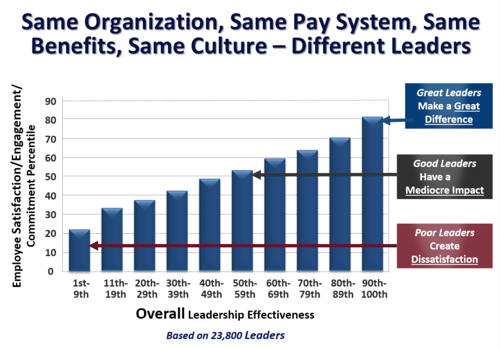 |
The bottom axis of this chart shows how about 250,000 people assessed the effectiveness of 23,800 leaders through 360 feedback assessments. The raters included the leader's manager, peers, direct reports, and others who work with him or her. The left vertical axis shows only how direct reports of these leaders rate their levels of satisfaction, engagement, and commitment.
To see a 2:20 minute excerpt of me explaining this chart at a workshop, click on The Impact of Leadership on Employee Engagement.
We've consistently seen this pattern over many years across all industries in large or smaller organizations. The message is clear; the single biggest employee engagement variable is the boss. Improve his or her leadership effectiveness and engagement increases. People join an organization but quit their boss.
Rather than quitting and leaving the organizations, many people quit and stay. This on-the-job-retirement or doing the least required to stay employed carries a huge cost.
Inspiring "Yes, I Can" Video Redefines Disability and Pushes the Limits

What's a disability? Merriam-Webster defines it as "a condition (such as an illness or an injury) that damages or limits a person's physical or mental abilities."
But just where are those limits and who defines them? The more we learn about the boundaries of human performance the more we understand how our perceptions shape our reality. Research in quantum physics, neurosciences, and positive psychology shows us that our limits are largely formed by our beliefs about what is and isn't possible.
The fifteenth Summer Paralympic Games wrapped up last month in Rio de Janeiro in front of large crowds and major international TV audiences. A powerful and inspiring three minute video was released earlier this summer to promote the games on Channel 4 in the UK. It's highly inspiring as it challenges perspectives and push boundaries. Entitled "Yes I Can: Superhumans," the video redefines disability and stretches -- or even snaps -- the limitations on what many people think is possible.
I was delighted to see Alvin Law opening the video with a high intensity drum roll. Alvin's an award winning musician who plays drums, piano, and trombone. Alvin was born without arms. He plays the drums with his feet.
Alvin was one of the babies born in the early sixties with missing or deformed limbs when mothers were prescribed Thalidomide to reduce morning sickness. His birth family put him up for adoption. Hilda Law became his foster mother -- and Chief Limit Stretcher. She helped Alvin reset his boundaries as he learned to use his feet and toes to get on with his life and pursue his dreams. She continually told him "there's no such word as can't."
Heather and I first met Alvin and his wife and business partner, Darlene, over 15 years ago through the Canadian Association for Professional Speakers. As we learned more of his life story -- such as raising his son as a single Dad -- we saw that Alvin was a rare and inspiring keynote speaker who lived his message.
Alvin's become a Hall-of-Fame speaker. He calls himself a "motivational rabble-rouser and attitude provocateur." He says "the best thing that ever happened to me is being born without arms. It brought me to circumstances never thought possible."
For a quick shot of high energy inspiration watch "Yes I Can: Superhumans," And watch the video clip through to the last interview featuring a bit of Alvin's story. You can also click here to learn more about Alvin. Near the bottom of the page is his blog post on making the video. As an avid Beatles fan I was fascinated to learn the song was recorded at Abbey Road Studios.
Henry Ford famously declared over a century ago "whether you think you can, or you think you can't -- you're right." So where's your line dividing what is and isn't possible? Where do you delineate what can and can't be done?
As Alvin says -- and shows even more powerfully with his life -- "we all have obstacles in life. It is ultimately our attitude that determines whether they block our path to success, or strengthen us on our journey."
Webinar: Accelerating Leadership Development: Why We Should Do This Now!

The great American founding father, author, and statesman, Benjamin Franklin, was highly devoted to lifelong learning and continual personal improvement. His book, The Art of Virtue (edited by George Rogers), is an inspiring account of Franklin's life and an instructive guide to his improvement process and personal effective system. Franklin once said, "If you empty your purse in your head, no one can take it away from you. An investment in knowledge always pays the best interest." Modern research shows that Franklin's advice on learning is as valid today as it was 200 years ago.
A key source of an organization's wealth in today's world is its capabilities. But many organizations fall victim to what we've called the The Law of Improvement Displacement -- short-term performance pressures drive out long-term improvement activities. The growth, development, and performance of many organizations, teams, and people is severely stunted by their failure to recognize and overcome this law.
Is your organization effective at identifying capable leaders early in their careers? You probably know them -- those young, highly professional individuals who wield influence and make important contributions to the organization. These individuals meet the criteria of true leaders, but are they receiving any kind of formal leadership development?
The dearth of leadership investment continues as more and more baby boomers retire and organizations are feeling their loss. What is the solution?
Last month Jack Zenger explored this common issue and identified vital solutions. In his 45 minute webinar he shared:
- Research and the importance of early development
- How to identify potential groups
- Competencies to pay attention to
- How to create a culture that values development
- Mistakes to avoid
- Positive results and outcomes
Click here to watch the archived webinar.
Learn how and where leadership development can produce the highest return on investment and create long term wealth.
Tweet Reading: Recommended Online Articles
 |
 |
This section summarizes last month's LinkedIn Updates and Twitter Tweets about online articles or blog posts that I've flagged as worth reading. These are usually posted on weekends when I am doing much of my reading for research, learning, or leisure. You can follow me on Twitter at https://twitter.com/JimClemmer
My original tweet commenting on the article follows each title and descriptor from the original source:
These charts starkly show how levels of leadership effectiveness are embedded in the culture that's set by senior executives.
"The Contagious Effect Of Good And Bad Leaders (How Are You Feeling Today?)" -- Jack Zenger
www.forbes.com
"This study shows two things very clearly: excellent leadership and bad leadership both cascade down the organization like a virus."
Drawing insights from research with over 300,000 respondents to clarify what a leader can do to instill pride in team members.
"It's Not In My Job Description': 5 Steps To Build Company Pride And A Sense Of Ownership" -- Joe Folkman
www.forbes.com
"Employees who are proud are less likely to quit, more likely to recommend the organization as a good place to work, and often do an excellent job of marketing company products to others."
Practical leadership/development tips providing a useful checklist, dos and don'ts, and illustrated by two case studies.
"How to Manage Managers" -- Amy Gallo, contributing editor at Harvard Business Review
https://hbr.org
"When you're managing managers, your responsibilities are two-fold: you need to make sure they're producing good work (as with any employee) and that they're effectively supporting their teams."
85% of executives feel talent development can make or break their organizations yet fewer than half are making the necessary investments.
"Opening The Leadership Pipeline: 3 Vital Steps You Should Be Taking Today" -- Jack Zenger
www.forbes.com
"I see a serious problem in the making. The world is about to experience a dearth of effective senior leaders."
Read The Leader Letter in Twice Weekly Installments

The items in each month's issue of The Leader Letter are first published in my twice weekly blog during the previous month.
If you read each blog post (or issue of The Leader Letter) as it's published over twelve months you'll have read the equivalent of a leadership book. And you'll pick up a few practical leadership tips that help you use time more strategically and tame your E-Beast!
Feedback and Follow-Up
I am always delighted to hear from readers of The Leader Letter with feedback, reflections, suggestions, or differing points of view. Nobody is ever identified in The Leader Letter without their permission. I am also happy to explore customized, in-house adaptations of any of my material for your team or organization. Drop me an e-mail at Jim.Clemmer@ ClemmerGroup.com or connect with me on LinkedIn, Twitter, FaceBook, or my blog!
May the Force (of strengths) be with you!

Jim Clemmer
President
Phone: (519) 748-5968
Email: jim.clemmer@clemmergroup.com
Website: www.clemmergroup.com


In this Issue:
| View PDF Version |
| Past Issues |
| Practical Leadership Blog |
| Visit Our Site! |
Let's Connect
 |
 |
 |
 |
 |
Share this!Please forward this newsletter to colleagues, Clients, or associates you think might be interested -- or on a 'need-to-grow' basis.Was this forwarded to you? Subscribe to receive The Leader Letter monthly! |
Permission to ReprintYou may reprint any items from The Leader Letter in your own printed publication or e-newsletter as long as you include this paragraph: "Reprinted with permission from The Leader Letter, Jim Clemmer's free e-newsletter. For almost thirty years, Jim's 2,000+ practical leadership presentations and workshops/retreats, seven bestselling books, columns, and newsletters have been helping hundreds of thousands of people worldwide. His web site is www.clemmergroup.com." |
Please forward this newsletter to colleagues, Clients, or associates you think might be interested -- or on a 'need-to-grow' basis.
Did you receive this newsletter from someone else?
Subscribe to ensure you don't miss the next issue!
The CLEMMER Group
10 Pioneer Drive, Suite 105, Kitchener ON N2P 2A4
Phone: (519) 748-1044 ~ Fax: (519) 748-5813
service@clemmer.net
www.clemmergroup.com
©2016 Jim Clemmer and The CLEMMER Group