


Issue 146 - May 2015
The Leader Letter

Plato once observed, "We can easily forgive a child who is afraid of the dark; the real tragedy of life is when people are afraid of the light." Ignoring or failing to understand how others see our behaviors keeps us in the dark and diminishes everyone's perceptions of our leadership effectiveness. Those perceptions then shape the reality of our leadership impact and outcomes.
A strong leader or coach doesn't protect people from themselves. Extraordinary leaders and coaches shine the light of feedback to constructively redirect negative behaviors and reinforce positive behavior.
Merriam-Webster dictionary defines feedback as:
- "helpful information or criticism that is given to someone to say what can be done to improve a performance, product, etc.
- something (such as information or electricity) that is returned to a machine, system, or process.
- an annoying and unwanted sound caused by signals being returned to an electronic sound system."
This issue publishes my April blogs spotlighting research, best practices, and core skills of seeking and giving feedback. Effective feedback provides the "helpful information" that dramatically improves our own and other's performance. In this issue we'll look at the biggest problems with most 360 feedback tools now widely in use and research showing the components of best-of-class 360 assessments so the feedback maximizes performance improvement.
You'll also find new research on the type, frequency, and barriers to informative feedback that can help systems, processes, and people get better. Feedback is data or information we often label as positive or negative. The key is objectively accepting, prioritizing, and turning this data or information into change.
We've all winced and covered our ears when experiencing the horrendous squeal of "an annoying or unwanted sound" in a loudspeaker system. If we don't effectively navigate the conundrums, ironies, and contradictions of feedback we can be deafened by the squeals of focusing on the wrong things, such as weaknesses. Or we might produce a squeal that overwhelms the person we've giving feedback to and they can't -- or won't -- hear our message.
We hope you reduce your fear of the dark side and find this issue enlightening!
New Research Paper on Feedback: The Powerful Paradox
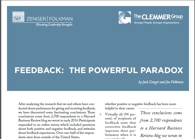
Last year Jack Zenger and Joe Folkman conducted a survey among readers of their Harvard Business Review blog readers. 2,700 responded to the online survey with questions about positive and negative feedback and attitudes about feedback experiences. This was an international survey with over half of the respondents coming from outside the United States.
Here are some of the findings:
Feedback: More or Less?
- The great majority of leaders tend to avoid giving feedback, especially corrective or negative feedback. 43 percent of leaders said they found that giving corrective feedback is a "stressful and difficult experience."
- Virtually every employee in the organization wants more feedback. Almost two-thirds agreed that "my performance and possibilities for success in my career would have increased substantially if I had been given more feedback."
- 64 percent of respondents said "they are not praised or recognized too much."
What type of feedback is most effective?
- About half of leaders tend to avoid giving positive feedback, while the other half describe themselves as comfortable giving positive feedback.
- Recipients of feedback say they much prefer receiving corrective feedback, but they are evenly split on whether positive or negative feedback has been more helpful in their career.
- Virtually all (94 percent) of recipients of feedback state that corrective feedback improves their performance when it is presented well.
- 63 percent of recipients felt that they get substantially more positive feedback than negative feedback.
- While 62 percent of leaders rated themselves as highly effective at providing others with honest, straightforward feedback, other research reports that 60 percent of employees say they have not received any useful feedback in the past six months.
The research paper also covers:
- Group preferences according to age and gender
- Complexity, intentions, and impact of feedback
- Barriers to providing feedback
- Assumptions and preferences for positive versus corrective feedback
- Importance of asking for feedback
- Importance of giving feedback
- How to give positive feedback
- How to give corrective feedback
Click on Feedback: The Powerful Paradox to download a complimentary copy of the research paper.
I am running our first public workshops (we've been running these inside organizations) of our recently updated 2-day Extraordinary Coach workshops in Mississauga on May 25 and 26 and Calgary on June 4 and 5. This session includes a powerful new session on Elevating Feedback and a 360 strengths-based feedback assessment on 14 coaching competencies. Click on The Extraordinary Coach Workshop for more details and to register.
Feedback Webinar: You Need It, Your Employees Want It!

We are often asked, "What is the one thing a person ought to do to be a better leader and have a more successful career?"
While it is difficult to narrow down the list to just one thing, there is one that seems to surface over and over again in our research. That one thing is having the ability to ask for and respond to feedback from others. When we look at our 360 survey data we can see an absolute correlation between the ability to ask for feedback and the overall effectiveness of leaders.
And giving effective feedback is a cornerstone coaching skill with major impact on employee engagement, performance management, teamwork, productivity, quality, and safety.
"The feedback report you're about to receive is a gift," is often greeted with nervous chuckles. And in some organizations when a manager says to an employee, "I'd like to give you a little feedback," it often quickens his or her heart rate and sends shivers up their spine.
In a new study we have been conducting, we've discovered that employees want feedback. Positive feedback is welcome, but they also want the negative or corrective feedback that most leaders are hesitant to give. Employees want it, leaders hate to give it.
Last month Jack Zenger and Joe Folkman explored this vital coaching and leadership development topic in a webinar. They shared new research about both asking for, and giving feedback, and how to get better at doing both.
Click here to view the archived feedback webinar "You Need It, Your Employees Want It!
Get a Complimentary Feedback Assessment
Webinar viewers have the opportunity to participate in our Feedback Practices & Perceptions Assessment at no cost. This self-assessment will measure:
- Your desire for giving and receiving positive and negative feedback
- Your overall feelings of self-confidence, since that trait correlates strongly with the desire to give and receive feedback
You can access the assessment here: Feedback Practices and Perceptions Assessment
Turning Feedback Into Change

Our research shows that leadership self-assessment correlates to performance outcomes like employee engagement, turnover, safety, customer service, or profitability only half as reliably as ratings from everyone else (manager, direct reports, peers, and others). Some leaders rate themselves much higher than all the other raters. Other leaders don't see their own strengths and assess their effectiveness much worse than everyone else does.
Leaders who get the most benefit from their 360 feedback assessments pass through three stages of Acceptance to Prioritization to Making Change Happen. Here's a summary of the key steps in each of these stages from Joe Folkman's white paper Turning Feedback Into Change:
Acceptance:
- Complete Honesty
- Concern for Others
- Valuing Differences
- Optimism
- Listening to Learn
Prioritization:
 |
The intersection of our strengths/competencies, passion, and organizational needs produces a powerful combination that sustains long term efforts to improve. It's one of the key reasons leaders building their strengths are rated 2 to 3 times higher in 360 reassessments 18 – 24 months after than those gritting their teeth and trying to improve weaknesses.
Making Change Happen:
- Find the Real Problem
- Move Toward Specific Goals
- Build a Support System
- Try it, You'll Like It (After a While)
- Don't Get Trapped by Beliefs
- Avoid Feeling Deprived
- Create Structure
- Have a Clear Vision
Click here for a complimentary download of Turning Feedback Into Change to get more information on each stage and it's steps.
Video Clip: Asking for Feedback on Coaching Effectiveness

The research behind development of The Extraordinary Coach included looking at best practices in helping professions such as counseling, clinical psychology, and social work. Two practical lessons that apply to coaching effectiveness were focusing on topics of importance and interest to the coachee and asking for feedback at the end of a coaching conversation.
When counselors asked for feedback on the effectiveness of their helping sessions, attrition rates were cut in half and effectiveness increased by 65%.
There are four key reasons to focus on the coachee's agenda and ask for feedback:
- Asking for input significantly changes the nature of the relationship from parent-child to adults talking with each other.
- Being asked for input changes the coachee's feelings of being in control and having power.
- The feedback changes the coach's behavior.
- Being asked for input changes the coachee's attitude toward and ratings of the coach's effectiveness.
Click on Asking for Feedback on Coaching Effectiveness to view a short video clip of me explaining some of this research and key points. I also show an example of a simple tool that can help coach's get immediate coachee feedback on the effectiveness of the coaching conversation.
Nine Problems with 360 Multi-Rater Assessments

Since feedback is so critical to leadership effectiveness and development, 360 Multi-Rater Assessments are used by over 90% of Fortune 500 companies. But many organizations are now experiencing these problems:
- Focusing on a leader's weaknesses and skill gaps -- many participants find the 360 process negative and punishing. Some executives are now banning 360s from their organizations because of the pain and suffering they can cause. Pre and post-tests prove that "Building Leadership Strengths is 2 – 3 Times More Effective Than Fixing Weaknesses".
- Survey questions lack validity -- Many competency models and 360 survey questions have little to no research on whether they are connected to performance outcomes. For example, charisma, time management, managerial courage, and executive presence are examples of dozens of competencies we've researched that don't predict or correlate to levels of employee engagement, safety, turnover, patient satisfaction, or quality.
- Rating scales create false positives -- standard "Agree/Disagree" scales often create a tight banding of data that make it difficult to differentiate between competent, strength, or profound strength.
- Providing normative averages -- showing leaders 75th and 90th percentile norms and how building their strengths can significantly elevate their performance and encourages greater developmental effort.
- Lack of personal connection to employee engagement -- employee engagement surveys show generally how engaged or satisfied employees are with the organization. Leaders need to see specifically how their behaviors impact their direct reports.
- Not all competencies are equal for every leader -- traditional leadership or competency models use a one-size-fits-all approach (some try tailoring to multiple organizational levels). What's missing is multi-rater feedback on which competencies matter most for that leader in that role.
- Written comments reinforce fixing weaknesses -- most participants skim the responses to the question asking for a list of strengths and dwell (even fixate) on the list of their weaknesses or improvement suggestions. All a leader really needs to know is whether a weakness is significant or a "fatal flaw" that needs immediate attention.
- No insights on how to build strengths -- traditional improvement plans flowing from 360s are focused on fixing weaknesses using a linear approach. What's missing is a research-based map showing how extraordinary leaders build a competency or strength from good to great.
- Too complex or too simple -- some very lengthy 360 assessments can take 30 – 60 minutes or more to complete. Reports are overly complex and confusing to interpret. At the other extreme, too few competencies and survey questions restrict the range of personally relevant and validated strengths leaders can leverage.
Further Reading:
- See 360 Assessments for a selection of blogs, articles, webinars, and video clips
- Research papers:
Components of a Best-of-Class 360 Assessment

Most 360 feedback assessments search for skill gaps, weaknesses, and training/development needs. We're running into executives who've refused to participate in 360 feedback assessments because they've found them negative and often feel beat up by the process -- even when they have the counsel of a well-trained coach or psychologist. Some CEOs have banned the use of 360 assessments in their organization.
Like a sharp blade, 360 feedback is a tool that can be constructive and helpful or cause lots of pain and destruction. It depends on the design of the tool and how it's used.
Most 360 assessments and development processes are focused on finding and fixing weaknesses. In a recent executive briefing I presented these key differences in a strengths-based 360 assessment:
- Simplified competencies and survey items based on predictive evidence.
- Ratings compared to extraordinary global norms, not averages.
- Rating scales that avoid false positives and little differentiation.
- Measure leadership effectiveness against key performance outcomes.
- Emphasis on building strengths not gaps/needs/weaknesses.
- Identify the key competencies most important to the leader's role.
- Written comments only focused on flagging any fatal flaws rather than listing weaknesses.
- An efficient survey process that takes about 15 minutes to complete.
- Simple, intuitive, and visual feedback reports.
- Provide insights to leaders on how to build his or her strengths.
You can view my five minute overview of these points recorded in this presentation at Major Differences in our Strengths Based 360.
You can also join me in experiencing and leveraging the power of a strengths-based 360 feedback process in our public workshops of The Extraordinary Leader or The Extraordinary Coach in Toronto or Calgary in May or June. Click on Leadership Development and Coaching Skills Workshops for more information and registration.
Strategies to Address Feedback Conundrums, Ironies, and Contradictions

360 feedback is critical to building strengths or addressing fatal flaws (as long as it avoids the "Nine Problems with 360 Multi-Rater Assessments" outlined above).
Over the past two years -- and especially in the past six months -- our revised, updated, and increased use of The Extraordinary Coach is proving to be equally powerful. It's also been personally rewarding to watch the resulting growth of participants I've been training or coaching. This coaching development system includes evidence-based approaches for giving and receiving feedback to build strengths or address critical issues.
And recently I've stepped up the number and depth of one-on-one executive coaching. These sessions are showing me a wide variety of effective and ineffective responses to leaders getting feedback and coaching on their leadership behaviors.
In their article, Feedback: The Leadership Conundrum for Talent Quarterly, Jack Zenger and Joe Folkman summarize their insightful research on how feedback can supercharge a leader's career and is at the heart of the coaching he or she provides to others. Here are the headlines of their key findings:
- Positive feedback for some is negative, and negative feedback for many is positive.
- People want to receive feedback, but they don't want to give it.
- Men are less inclined than women to give corrective feedback.
- One size does not fit all when it comes to feedback.
- Age does not change the willingness to give corrective feedback, but does increase receptivity to receiving corrective feedback.
- Giving and receiving feedback does not improve with seniority.
- Feedback is an unnatural act, both on the giving and receiving end.
- Nearly all the development focus is on the giver of feedback while the receiver is in complete control of the success of the outcome.
- Feedback should ideally flow upward as well as downward.
- Receivers of feedback are fearful, despite the giver's intention to be helpful.
- Like powerful medicines, feedback has the potential to do enormous good, and it can also do harm when misused or done poorly.
These findings sure resonate with my experiences over the past few years. Which ones apply most to your personal leadership development and your skills at coaching others? Which points are most critical to your organization's leadership development and coaching efforts?
The article offers ten simple strategies to deal with the "ironies and contradictions that swirl around feedback." Click Feedback: The Leadership Conundrum to read more about the findings and strategies.
Case Study Measures Impact of Building Strengths and Addressing Fatal Flaws

As part of succession planning many organizations are concerned about developing their next generation of senior leaders. Many large companies in well-established industries like financial services, resources, manufacturing, and the like or public sector, education, and healthcare organizations struggle with getting middle and senior managers to embrace leadership development opportunities.
We've recently published a case study from the banking industry with a number of high-level leaders nearing retirement. This large North American bank wanted to ensure future success by increasing the level of leadership effectiveness across the organization. The development process began with a 360 strengths-based assessment of all eighty leaders.
 |
After the feedback was collected, each leader received their individual results, attended a day-long development workshop and then created an individual development plan. Each leader was asked to discuss their development plan with their manager so that they would be supported in the process. Three months after the workshops, all managers were given a follow-up survey assessing their subordinate's efforts to improve. Managers were also asked to meet regularly with their direct reports to discuss progress. After eighteen months, all leaders participated in a reassessment of their leadership skills to assess progress.
Here are a few key conclusions and outcomes:
- One of the most significant keys to improving the overall leadership effectiveness score was to involve managers so that they would encourage and support the development of their direct reports.
- After eighteen months of developmental activities, the post-test results showed a significant level of improvement. The overall effectiveness score for the group of eighty leaders was at the 65th percentile or 15 percentile points above average.
- By using non-linear development techniques (cross-training) to build strengths, 34% of the leaders were able to increase the number of competencies at the 90th percentile.
- Eleven leaders with fatal flaws, were able to move from the 20th percentile in the pre-test results to the 50th percentile in their post-test.
- Leaders who decided to focus on fixing their weaknesses showed a 12 percentile point improvement. Leaders who chose to build their strengths made a 26 percentile gain in overall leadership effectiveness.
- The average level of employee engagement in their pre-test for those leaders who improved was at the 60th percentile. The post-test results showed a significant improvement to the 71st percentile.
Read the full case study here.
Good Advice on Seeking and Giving Advice

A recent Harvard Business School newsletter summarized research from David Garvin, the C. Roland Christensen Professor of Business Administration at Harvard Business School, and Joshua Margolis, professor in the Organizational Behavior unit at Harvard Business School. They point out that effective leaders need good advice and need to give useful advice to others. "Yet business executives aren't always making the most of advice -- on both the giving and the receiving end -- because they may not realize that it involves skills that can be learned and refined."
Some leaders can appear indecisive and uncertain in looking for too much advice and get rated poorly in their leadership effectiveness. Others march forward overly confidently and rarely ask for advice. They're also rated lower in leadership effectiveness. More balanced leaders in the middle are rated highest in their effectiveness.
Garvin and Margolis identify three key mistakes leaders make in seeking advice:
- Choosing the wrong advisers, particularly by turning only to those with like-minded ideas, rather than seeking out people who will provide a devil's advocate point of view.
- Defining the problem poorly, either by taking the conversation to unrelated tangents or by omitting key information that might cast the advice-seeker in a poor light.
- Misjudging the quality of the advice they are given.
This aligns with our experience on leader's seeking feedback and advice on their leadership effectiveness. It's also why 360 multi-rater assessments can be so useful.
Giving advice is a key function of training, mentoring, or managing performance. Extraordinary coaches refrain from advice giving and guide conversations so the answers are drawn from the coachee through a skillful coaching conversation that expands everyone's understanding of the issue and possible solutions.
Three advice-giving mistakes identified by Garvin and Margolis are traps many aspiring coaches too easily fall into -- especially misdiagnosis:
- Communicating the advice poorly.
- Misdiagnosing a problem, either by prematurely believing you see similarities with issues you have faced or by neglecting to ask the kind of probing, relevant questions that will get to the heart of the matter.
- Giving self-centered guidance.
If you want to know more, my advice to you is to read "Advice on Advice".
Tweet Reading: Recommended Online Articles


This section summarizes last month's LinkedIn Updates and Twitter Tweets about online articles or blog posts that I've flagged as worth reading. These are usually posted on weekends when I am doing much of my reading for research, learning, or leisure.
My original tweet commenting on the article follows each title and descriptor from the original source:
"When you love what you're doing you never have to work again" was useful advice I was given early in my career.
"How To Escape 'Day Prison' At Work" -- Joe Folkman
www.Forbes.com
"People show up to work in the morning, and as they enter their work area they can feel the bars closing around them and the cell door locking. In day prison people are unmotivated, dissatisfied and far less productive than they could be."
Discussion of how the latest research from Positive Psychology aligns with strengths-based leadership development.
Podcast: Dramatic Increase in Strengths-Based Approaches
www.Zengerfolkman.com
"Jack Zenger interviews Michelle McQuaid, a renowned speaker and thought leader in the strengths-based movement. Michelle has presented to and taught over hundreds of events, seminars, and workshops and the author of several books on the topic."
Use the PACE self-assessment and see how to be an extraordinary leader who does things fast AND does things right.
"8 Ways To Get Work Done Faster" -- Joseph Folkman
www.Forbes.com
"In the 1970's executives received about 1,000 messages per year. If you contrast that with the 30,000 messages executives received in the 2010's, you can see the expectations emerging through more than 120 messages per workday."
Joe gave a complimentary webinar on this critical leadership topic here.
"The One Thing That Can Supercharge Your Career" -- Joe Folkman
www.Forbes.com
"The way others view you is much better than the way you view yourself. We don't spend countless hours looking in the mirror, but others spend countless hours looking at us."
The eight dissatisfaction factors provide a good checklist for self- assessment and assessing disengagement risks.
"Why You Should Watch Out for Your 5-Year Job Anniversary"-- Jack Zenger and Joseph Folkman, Harvard Business Review
https://hbr.org
"Don't let yourself become a prisoner. A factor analysis on the items on employee feedback surveys that drew the most significantly negative responses identified eight critical issues..."
Read The Leader Letter in Twice Weekly Installments

The items in each month's issue of The Leader Letter are first published in my twice weekly blog during the previous month.
If you read each blog post (or issue of The Leader Letter) as it's published over twelve months you'll have read the equivalent of a leadership book. And you'll pick up a few practical leadership tips that help you use time more strategically and tame your E-Beast!
Feedback and Follow-Up
I am always delighted to hear from readers of The Leader Letter with feedback, reflections, suggestions, or differing points of view. Nobody is ever identified in The Leader Letter without their permission. I am also happy to explore customized, in-house adaptations of any of my material for your team or organization. Drop me an e-mail at Jim.Clemmer@ ClemmerGroup.com or connect with me on LinkedIn, Twitter, FaceBook, or my blog!
May the Force (of strengths) be with you!

Jim Clemmer
President
Phone: (519) 748-5968
Email: jim.clemmer@clemmergroup.com
Website: www.clemmergroup.com


In this Issue:
| View PDF Version |
| Past Issues |
| Practical Leadership Blog |
| Visit Our Site! |
Let's Connect
 |
 |
 |
 |
 |
Share this!Please forward this newsletter to colleagues, Clients, or associates you think might be interested -- or on a 'need-to-grow' basis.Was this forwarded to you? Subscribe to receive The Leader Letter monthly! |
Permission to ReprintYou may reprint any items from The Leader Letter in your own printed publication or e-newsletter as long as you include this paragraph: "Reprinted with permission from The Leader Letter, Jim Clemmer's free e-newsletter. For almost thirty years, Jim's 2,000+ practical leadership presentations and workshops/retreats, seven bestselling books, columns, and newsletters have been helping hundreds of thousands of people worldwide. His web site is www.clemmergroup.com." |
Please forward this newsletter to colleagues, Clients, or associates you think might be interested -- or on a 'need-to-grow' basis.
Did you receive this newsletter from someone else?
Subscribe to ensure you don't miss the next issue!
The CLEMMER Group
10 Pioneer Drive, Suite 105, Kitchener ON N2P 2A4
Phone: (519) 748-1044 ~ Fax: (519) 748-5813
service@clemmer.net
www.clemmergroup.com
©2015 Jim Clemmer and The CLEMMER Group