


Issue 209 - August 2020
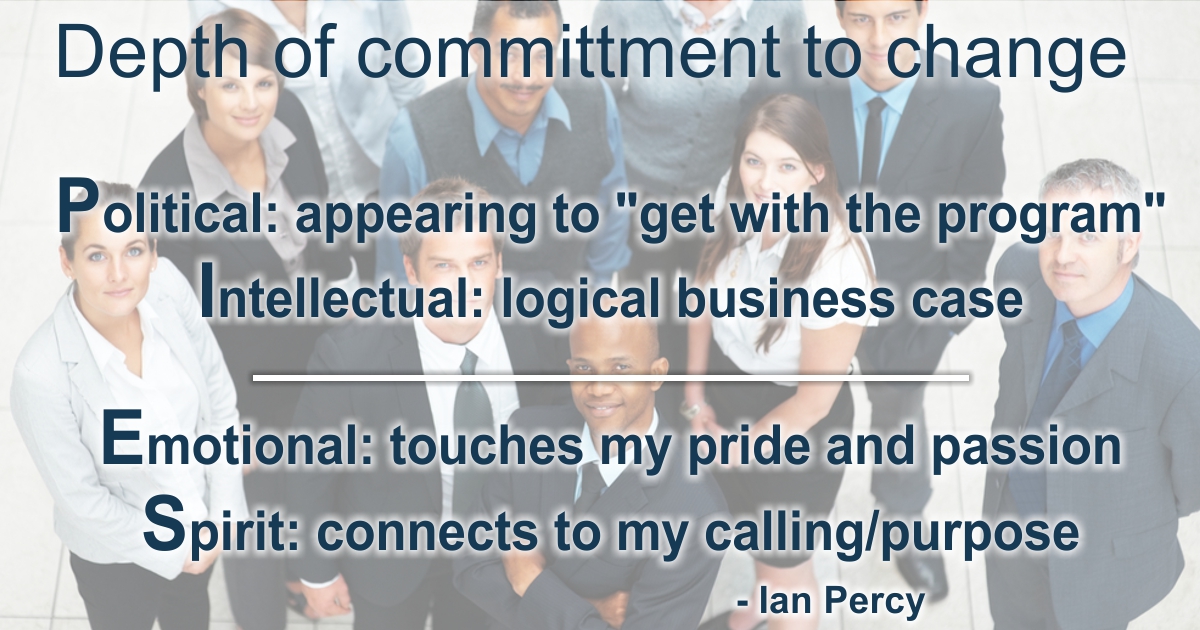
In his book, Going Deep, psychologist, Ian Percy outlines a useful change framework. The PIES model helps to chart the depth of commitment to personal, team, or organizational change. The deeper the commitment, the more lasting the change.
The first and most superficial level is Political. Appearances are everything. We make a "politically correct" change to show that we'll "get with the program." The next level is Intellectual. Here, a good business case or logical argument wins the day. Facts and analysis convince us the change makes sense. These first two levels deal with the head. They're about doing the change.
At the deeper third level, Emotional, we're dealing with the heart. The change feels right. We want to make it happen because it excites us. The fourth, and deepest level of commitment, is Spiritual. We make the change because it's in step with our deeper selves. The change is a transformation that aligns with our sense of purpose. At this level, Ian explains, "there is no gap and no separation between belief and action. The gap has been filled by the very essence of who you are. You and the object of your commitment have become one." This is about being the change.
This issue starts with a look at balancing the head of management and the heart of leadership. Do people make changes because they're pushed and feel they have to, or do they make changes because they're pulled and want to? To lead is to take ourselves and others to the deeper levels of heart and soul. That's especially important in these turbulent times.
A core element of strong leadership is a culture of openness and transparency. People speak their truth. Respectfully and tactfully, like a good game official, they "calls 'em as they sees 'em." A sign of poor management is smothering silence. This fosters a moose infestation. In this issue, you'll see moose tracks and find links for moose hunting.
Strong leaders build confidence and energize people for the long haul with small wins. We'll never run a marathon a day for 143 days like Terry Fox. But like him, we need short-term goals and a sense of progress to keep us moving forward. You'll find suggestions to engage and energize heartfelt effort.
Helping people want to change is a vital beginning point. Helping them learn how-to change is then pivotal. But many studies show a "great training robbery." Most learning and development efforts don't work. Often, they're wasteful and impede progress. Or learning and development ignites deep, transformational change. We'll look at four factors that distinguish success or failure.
Hope you dig into this issue and deepen your leadership.
Balancing Management and Leadership: What's Your Power Source?

Should leaders push or pull? Light a fire under people or stoke the fire within? Use position or persuasion power? Control with rules and policies or foster commitment with values and trust?
Finding the right balance of management and leadership is a continuous challenge. Less effective managers use position power and get people doing things because they have to. More effective leaders use persuasion power to get people doing the same things because they want to.
Despite declaring otherwise, the actions of managers who are less effective show underlying values when they treat people like children and "snoopervise" to keep them in line. Managers often hide behind rules and policies. They use position power to cover up weak people-leadership skills.
Leaders' actions show the underlying values of trust. They assume people are responsible adults. Leaders enforce rules and policies as a last resort when persuasion power has failed. Leaders continue expecting the best from people even when they see the worst from a few. They'd rather be occasionally taken advantage of than bring everyone down to rule-bound mediocrity.
Management |
Leadership |
Processes |
People |
Facts |
Feelings |
Intellectual |
Emotional |
Head |
Heart |
Position power |
Persuasion power |
Control |
Commitment |
Problem-solving |
Possibility thinking |
Reactive |
Proactive |
Doing things right |
Doing the right things |
Rules |
Values |
Goals |
Vision |
Light a fire under people |
Stoke the fire within people |
Written communications |
Verbal communications |
Standardization |
Innovation |
Which is more important, management or leadership? The answer is yes. We need both. It's about balance. As decades of Emotional Intelligence research shows, the greatest results clearly come from starting with leadership and falling back to management when needed.
Elizabeth Long Lingo, assistant professor at Worchester Polytechnic Institute and Kathleen McGinn, professor at Harvard Business School, recently reported on decades of research and consulting on the use of power. They conclude their recent Harvard Business Review article, "A New Prescription for Power," by pointing to an age-old leadership challenge that really isn't new at all:
"The appropriate use of power is one of the most fundamental and contentious questions of the human condition. Leaders can mobilize energy for personal gain or for collective interests; to enhance potential or destroy it. A thoughtful approach to power requires a nuanced analysis of the intended and unintended effects of influence and close attention to the means as well as the ends."
People want decisive and strong management -- when it's called for. But how position power is used makes all the difference. As much as possible, strong team leaders gather broad input and give people a chance to have their say. Once they made a tough or unpopular decision, he or she reiterates the reasons for it and solicits the support of others.
During these challenging times, balancing information and communication is especially important. Management speaks to the head with information technologies and written communication. Leadership engages the heart with courageous conversations and verbal communications.
How's your balance? Are you rowing in circles by pulling too hard on the management oar?
Smothering Silence: What You Don't Know Can Kill You

Is this happening in your team?
- People are texting each other with that they really think during a video or conference call
- The real conversation happens after the meeting or call
- Your team doesn't debate all sides of important issues and avoids touchy topics
- People agree to a plan of action but then do something else
- Personal accountability is avoided, deadlines missed, and commitments aren't kept
- A few vocal people dominate conversations and cut-off dissenting opinions
- Once the leader gives their opinion everyone else agrees or stays silent
These are "moose tracks." They're signs of moose-on-the-table -- a very Canadian metaphor. You might call them elephants-in-the-room or 800-pound gorillas. Whatever they're called, they're symptoms of silence that's not golden. It can be literally -- dead silence. It kills -- ideas and people.
On reviewing research from the Agency for Healthcare Research and Quality, U.S. Department of Health and Human Services, Steve Harden said, "47% of staff feel free to question the decisions or actions of those with more authority…the data tells us that if any hierarchy is present in the interaction, over 50% of staff will not speak up. This is a serious patient safety issue."
Many leaders recognize the problem -- in others. Most leaders proclaim they have open doors and welcome feedback. But often there's a big disconnect between good intentions and behaviour. In "So You Think You're a Good Listener," Patrick Barwise and Seán Meehan report "Our research -- based on Personnel Decisions International's surveys of over 4,000 U.S. managers across various industries and functions revealed the gap between managers' self-evaluations and colleagues' assessments is widest when it comes to gauging receptiveness to hearing about difficult issues...in most boss-subordinate relationships, superiors overestimate their openness to receiving difficult messages and simultaneously underestimate the extent to which the power difference discourages subordinates from speaking their minds."
A Corporate Executive Board poll found that nearly half of executive teams don't get critical information because employees are afraid to be the bearers of bad news. Clearly, many messengers are being shot when they don't tell their bosses what they want to hear. Only 19% of executive teams are promptly given bad news that could have a big impact on the firm's performance.
Not only does silence hurt organizations, it increases employee stress and burnout. Based on a meta-analysis of multiple studies and their own follow up study of 405 employees of different companies, Michael Parke and Elad Sherf concluded, "people can more easily live with lethargy or a lack of enthusiasm (not being encouraged to contribute) than with fear (worrying about calling out a problem)." The title of their article warns, "you might not be hearing your team's best ideas."
Do you have a moose problem? Take our short quiz to do some moose hunting. Do you have and open door and closed mind? How do you know? That's the critical question. Many leaders suffer from optical delusion. They can't see the moose because people aren't speaking up, pushing back, or giving honest feedback. Silence creates blissful ignorance...until big problems seem to pop out nowhere -- like a moose crashing through your car's windshield as you're driving through the fog.
Do you hear that? If you're picking up sounds of moose or seeing a few tracks, click here for tips to reduce the moose.
Every Little Thing: Step Small for the Long Haul

This month is the fortieth anniversary of Terry Fox's Marathon of Hope run through our community - Waterloo Region. Having lost a leg to cancer, Terry Fox embarked on a cross-Canada run to raise money for cancer research. Terry's shuffle-and-hop running style took him about 42 kilometers or 26 miles per day! I think jogging for 30 minutes in the morning is pretty good. Some people train for months to run a single marathon (26 miles). Terry ran a marathon a day for 143 days -- on an artificial leg! When asked how he kept himself going out with thousands of miles ahead of him, he replied, "I just keep running to the next telephone pole."
Tragically, cancer spread to his lungs, and he was forced to abandon his run. A few months later, he died. His inspiring legacy continues to this day in annual Terry Fox runs that have raised tens of millions of dollars for cancer research.
Terry came to mind when I read Bill Taylor's article, "To Solve Big Problems, Look for Small Wins." He writes, "It is tempting, during a crisis as severe as the Covid-19 pandemic, for leaders to respond to big problems with bold moves...(But) the best way for leaders to move forward isn't by making sweeping changes but rather by embracing a gradual, improvisational, quietly persistent approach to change."
In "The Power of Small Wins" Harvard professor Teresa Amabile and researcher and consultant Steven Kramer discovered the best way to motivate people is to "help them take a step forward every day...nothing contributed more to a positive inner work life (the mix of emotions, motivations, and perceptions that is critical to performance) than making progress in meaningful work...the key is to learn which actions support progress -- such as setting clear goals, providing sufficient time and resources, and offering recognition."
Strong leaders build on successes and string together incremental gains to boost short-term confidence for the long-term journey. Recognizing and celebrating successes and small wins is energizing.
Here's a few suggestions:
- Celebrate progress and look for steps in the right direction that you and the team can build on.
- Periodically list what's going well or list your team's accomplishments. Use it as the basis for celebrations, appreciation, and recognition.
- Give everyone lots of information and feedback and make it as transparent and visible as possible.
- Ensure senior managers are leading efforts to recognize, celebrate, and appreciate small wins.
- Make recognition immediate. Otherwise, the excitement or connection to why it was significant will be lost.
- Provide plenty of training, follow-up, encouragement, and personal examples for leaders to give personal one-on-one recognition and thanks.
- Focus on helping people and teams leverage their strengths. Align/assign work and/or remove barriers to allow people to do more of what they do best.
- Develop "walls of fame," "alcoves of excellence," or posting pictures, awards, performance/achievement charts, appreciative letters, and success stories.
We know that one of the competencies leveraged by some extraordinary leaders is setting stretch goals. Terry Fox certainly set a Big Hairy Audacious Goal (BHAG) to run across Canada on an artificial leg. But then -- as that puzzling metaphor recommends -- he ate the elephant one bite at a time by running to the next telephone pole.
How's your progress? Are you energizing your big challenges by celebrating your small wins?
Further Reading
- Giving Thanks Through Recognition, Appreciation, and Celebration
- Manipulating Isn't Motivating: Use These Powerful Approaches to Engage and Energize
- Recognition Do's and Don'ts to Inspire and Energize
4 Ways Learning and Development Ignites or Impedes Culture Shift
Recently, I delivered a virtual keynote presentation to a national forum of senior executives on leading change and culture development. During these crazy times, strong leadership is more critical than ever.
A central focus of the forum was the pivotal role of learning and development in change efforts. I presented four points that generated a lively debate in a panel of change experts and seasoned executives. We discussed how these points determine whether changes will succeed or fail:
Shift Wrapping: Understanding and Buy-In Are Critical to Culture Change
If team members don't share their leader's urgency for change, the effort will fail. That's especially true of today's "Generation Why." Most people -- and especially millennials -- won't follow leaders who don't help them understand why shifts are needed.A common change leadership trap is confusing information and communication. Like a doctor hearing a complaint of a headache, communication problems are often signs of deeper issues. There's rarely a quick and easy solution. We've found eight interconnected causes of communication breakdowns.
Don't Step in the Leadership: Behaviors Flow Downhill
The most effective communication is verbal. The most believable communication is behavior. Many leaders are frustrated that people in their organizations aren't getting their messages. But they are. They see the message loud and clear. You can't change "them." You have to change us.Leaders who don't visibly model the culture change they want are on that road to insanity; doing the same thing while expecting different results. Too often, leaders are me-deep in fooling themselves. They don't realize how their audio and video aren't in sync because they're not getting unfiltered feedback on their behavior.
The Great Training Robbery: 90% of Development Efforts Don't Change Behavior
Leadership development is mostly ineffective. One reason is a "once and done" approach to dunking trainees in the training tank. This can make things worse by raising awareness without shifting behavior.We've found a simple formula for lasting and effective leadership and organization development; B = P x C. That is, Behavior is a factor of Personal development multiplied by the organization's Culture. Are you culprit in the great training robbery?
Time to Skill: Want-To Needs How-To
Leaders often believe motivation leads to application. Sometimes that's true. Some people know what to do, but aren't doing it. More often, people want to be more effective but don't know how. We frequently see this in our executive coaching programs. These start with a 360 assessment.Lower rated leaders have often been frustrated by their low impact on engagement, service levels, safety, quality, etc. By learning to build on their strengths, leaders can find their leadership sweet spot at the maximum leverage point of their strongest competencies, passion, and organizational needs.
Are your learning and development efforts igniting or impeding your culture development efforts. How do you know?
Bridging the Distance: Reading, Leading, and Succeeding

Leaders bring hope, optimism, and positive action. That's really tough to do while social distancing and facing an uncertain future. We multiply misery if we allow the pessimism plague to infect us as well.
To counter Headline Stress Disorder and strengthen resilience, I actively scan a list of resources for research, articles, and tips on leading ourselves and others through these turbulent times. I post those articles every day.
Let's shorten our social media distancing. Follow or connect with me:
 LinkedIn and follow The CLEMMER Group
 Twitter
 Facebook
Together we can Learn, Laugh, Love, and Lead -- just for the L of it!
Read The Leader Letter in Weekly Installments
 |
The items in each month's issue of The Leader Letter are first published in my weekly blog during the previous month.
If you read each blog post (or issue of The Leader Letter) as it's published over twelve months, you'll have read the equivalent of a leadership book. And you'll pick up a few practical leadership tips that help you use time more strategically and tame your E-Beast!
Feedback and Follow-Up
I am always delighted to hear from readers of The Leader Letter with feedback, reflections, suggestions, or differing points of view. Nobody is ever identified in The Leader Letter without his or her permission. I am also happy to explore customized, in-house adaptations (online these days) of any of my material for your team or organization. Drop me an e-mail at jim.clemmer@clemmergroup.com or connect with me on LinkedIn, Twitter, Facebook, or my blog!
Let's leverage our leadership strengths to work together and get through this challenging time.

Jim Clemmer
President
Phone: (519) 748-5968
Email: jim.clemmer@clemmergroup.com
Website: www.clemmergroup.com


In this Issue:


| View PDF Version |
| Past Issues |
| Practical Leadership Blog |
| Visit Our Site! |
Let's Connect
|
|
|
 |
Share this!Please forward this newsletter to colleagues, Clients, or associates you think might be interested -- or on a 'need-to-grow' basis.Was this forwarded to you? Subscribe to receive The Leader Letter monthly! |
Permission to ReprintYou may reprint any items fromThe Leader Letter in your own printed publication or e-newsletter as long as you include this paragraph. "Reprinted with permission from The Leader Letter, Jim Clemmer's free e-newsletter. For almost forty years, Jim's 2,000+ practical leadership presentations and workshops/retreats, seven bestselling books, columns, and newsletters have been helping hundreds of thousands of people worldwide. His web site is www.clemmergroup.com." |
Please forward this newsletter to colleagues, Clients, or associates you think might be interested -- or on a 'need-to-grow' basis.
Did you receive this newsletter from someone else?
Subscribe to ensure you don't miss the next issue!
The CLEMMER Group
476 Mill Park Drive, Kitchener ON N2P 1Y9
Phone: (519) 748-1044 ~ Fax: (519) 748-5813
service@clemmergroup.com
www.clemmergroup.com
©2020 Jim Clemmer and The CLEMMER Group